
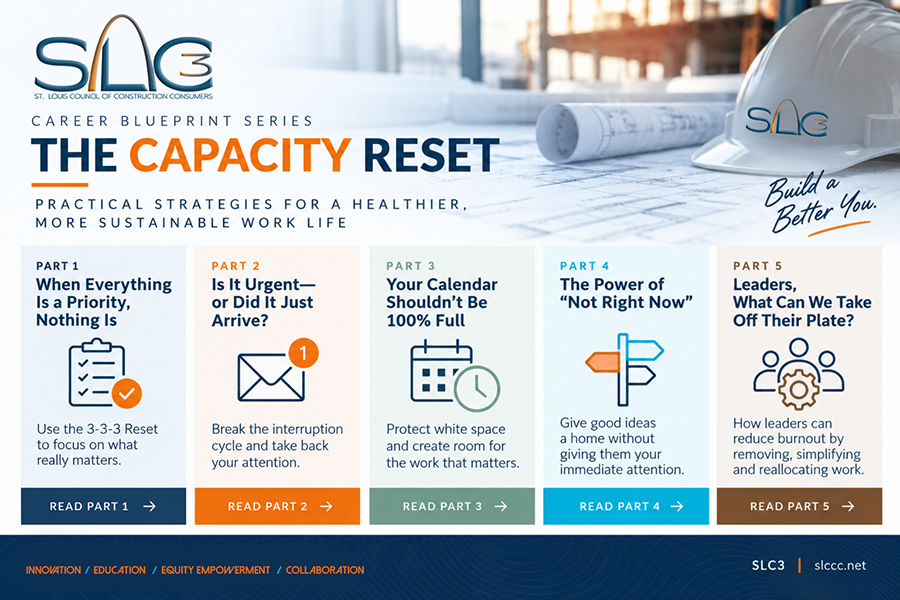
When someone on your team is overwhelmed, what’s our first instinct?
We may suggest better time management.
Delegate more.
Prioritize.
Set boundaries.
Take some time off.
Those can all be helpful.
But sometimes we’re asking the wrong question.
Instead of asking:
“How can you manage all of this better?”
Maybe we should ask:
“What can we take off your plate?”
Sometimes the Workload Really Is the Problem
Burnout isn’t always caused by poor time management.
Sometimes there is simply too much work.
This can become particularly challenging in AEC, where staffing shortages, compressed schedules, changing project demands, client expectations and deadlines can quickly create overload.
And your strongest performers may be the people least likely to tell you.
They’re dependable.
They figure things out.
They stay late.
They answer the email.
They take on the additional project.
And because they continue delivering, we assume they’re managing just fine.
Until they’re not.
Don’t Reward Competence With More Work
There’s an unfortunate pattern that happens in many workplaces:
The person who gets things done gets more things to do.
We trust them, so we give them another responsibility.
Then another.
Then another.
Eventually, your most dependable employee becomes your most overloaded employee.
Leaders need to pay attention not only to performance, but also to capacity.
Just because someone can handle something doesn’t mean they should continually be asked to.
Ask Better Questions
Instead of simply asking, “How are things going?” try getting more specific.
Ask:
What is taking more time than it should?
What are you doing that someone else could handle?
What deadline could realistically move?
What meeting could you stop attending?
What process are we doing simply because we’ve always done it?
And perhaps most importantly:
If we add this new priority, what should become less important?
That last question can change a team’s culture.
Try the Stop, Simplify, Delegate, Delay Exercise
When someone is overloaded, look at their responsibilities together and put them into four categories:
STOP — What doesn’t provide enough value to continue?
SIMPLIFY — What still needs to happen but doesn’t need to be this complicated?
DELEGATE — What could someone else own?
DELAY — What matters, but doesn’t need to happen now?
Not everything will fit neatly into one of these categories.
That’s okay.
Finding even one or two things can create breathing room.
Watch Your Best People
One of the biggest burnout warning signs isn’t always poor performance.
Sometimes it’s continued high performance at an increasingly high personal cost.
Pay attention to the person who’s always available.
The person who never says no.
The person responding late at night.
The person everyone goes to when something needs to get done.
Don’t wait for that person to tell you they’ve reached their limit.
Check in.
Your Challenge This Week
Choose one person on your team and have a capacity conversation.
Don’t start with:
“Are you overwhelmed?”
You may automatically hear, “No, I’m fine.”
Instead ask:
“What’s taking up too much of your time right now?”
Then listen.
And before offering another productivity strategy, ask one more question:
“What can I help take off your plate?”
Sometimes preventing burnout isn’t about helping people become better at carrying an impossible load.
It’s making the load lighter.