
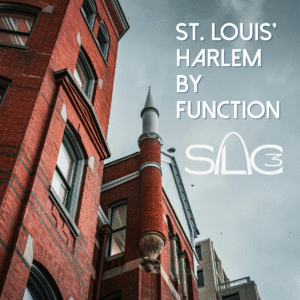
St. Louis didn’t have a neighborhood officially called “Harlem,” but it did have areas that played a very similar cultural role for Black life, arts, and business — most notably The Ville.
The Ville = St. Louis’ “Harlem.”
From the early 1900s through the mid-20th century, The Ville (north of Delmar Boulevard) was the heart of Black St. Louis. Because of segregation and redlining, it became a concentrated center of:
- Black-owned businesses
- Music, arts, and nightlife
- Professional Black families (doctors, teachers, lawyers)
- Civil rights organizing
Just as in Harlem, New York, it was a place where Black culture flourished despite segregation.
Big names tied to The Ville
Some seriously iconic people lived in or passed through the neighborhood:
- Chuck Berry
- Tina Turner
- Josephine Baker
- Miles Davis
- Dick Gregory
- Annie Malone (one of the first Black female millionaires in the U.S.)
That concentration of talent is a big reason people compare it to Harlem.
Why you might’ve read “St. Louis’s Harlem.”
Writers and historians sometimes informally call The Ville “the Harlem of St. Louis” because:
- It filled the same cultural and economic role
- It was shaped by similar Great Migration patterns
- It declined later for similar reasons (desegregation + disinvestment)
Significant historical landmarks:
The Ville is packed with history. Here are some of the most important historic buildings and sites in the neighborhood, with why they matter:
🏛️ Sumner High School (1915) 4248 W. Cottage Ave
- One of the oldest Black high schools west of the Mississippi
- Educated an astonishing number of prominent Black leaders
- Alumni include Tina Turner, Dick Gregory, Arthur Ashe, and more
- Still standing and still iconic
🏠 Shelley House (c. 1870s) 4334 Easton Ave (now Dr. Martin Luther King Dr.)
- Home of George L. Vaughn, a major civil rights attorney
- Center of legal strategy against segregation in St. Louis
- Listed on the National Register of Historic Places
🏫 St. Nicholas Elementary School (1898)
- Early and important institution for Black education
- Part of the broader educational backbone of The Ville
🏡 Annie Malone House (c. 1910), 2612 Annie Malone Dr
- Home of Annie Turnbo Malone, one of the first Black female millionaires in the U.S.
- Founder of Poro College and the Annie Malone Children & Family Service Center
- Her success helped fuel Black wealth and philanthropy in The Ville
🏘️ The Ville’s Historic Homes (Cottage Ave, Maffitt Ave, C.D. Banks Ave)
- Rows of early 20th-century brick homes built for Black professionals
- Doctors, teachers, musicians, and entrepreneurs lived here
- Not one building, but collectively hugely important
⛪ St. Matthew the Apostle Catholic Church (1915)
- One of the first Catholic parishes serving Black residents in the area
- Played a role in community organizing and education
🎶 Chuck Berry’s Childhood Home
- Berry grew up in The Ville (exact house varies by source, but the area is well documented)
- The neighborhood deeply influenced early rock ’n’ roll through him and others
🧱 Former Poro College Site (nearby, historically tied)
- While not fully within today’s Ville boundaries, Poro College was closely connected
- A massive Black-owned business and campus that shaped the area’s economy
🏘️ The Ville Historic District
- The neighborhood itself is listed as a National Register Historic District
- Protects the street layout, housing styles, and cultural significance
Why these buildings matter
Together, they tell the story of:
- Black self-determination under segregation
- A thriving cultural and professional ecosystem
- Why The Ville earned comparisons to Harlem
Why African American History Month matters
At its core, Black History Month exists because American history was deliberately incomplete for a long time.
For generations, schools, textbooks, museums, and public memory have either:
- Left Black people out entirely
- Reduced them to slavery only
- Or framed their contributions as “side stories” instead of central ones.