There was a time when construction companies competed primarily on the projects they built.
Today, they’re also competing on something far less visible—but equally important.
They’re competing for people.
Across the country, and here in the St. Louis region, contractors are facing one of the most competitive labor markets in decades. Experienced project managers, estimators, superintendents, VDC specialists, engineers, and skilled tradespeople remain in high demand, while fewer young professionals are entering the industry than are retiring from it.
As a result, leading firms are rethinking more than compensation packages and benefits. They’re taking a closer look at the entire employee experience—from professional development and workplace culture to the physical spaces where their teams collaborate each day.
It’s a trend that extends far beyond office aesthetics. It’s about creating an environment where talented people choose to build long-term careers.
The Workplace Has Become Part of the Brand
For years, the office was simply where work happened.
Today, it has become an extension of a company’s identity.
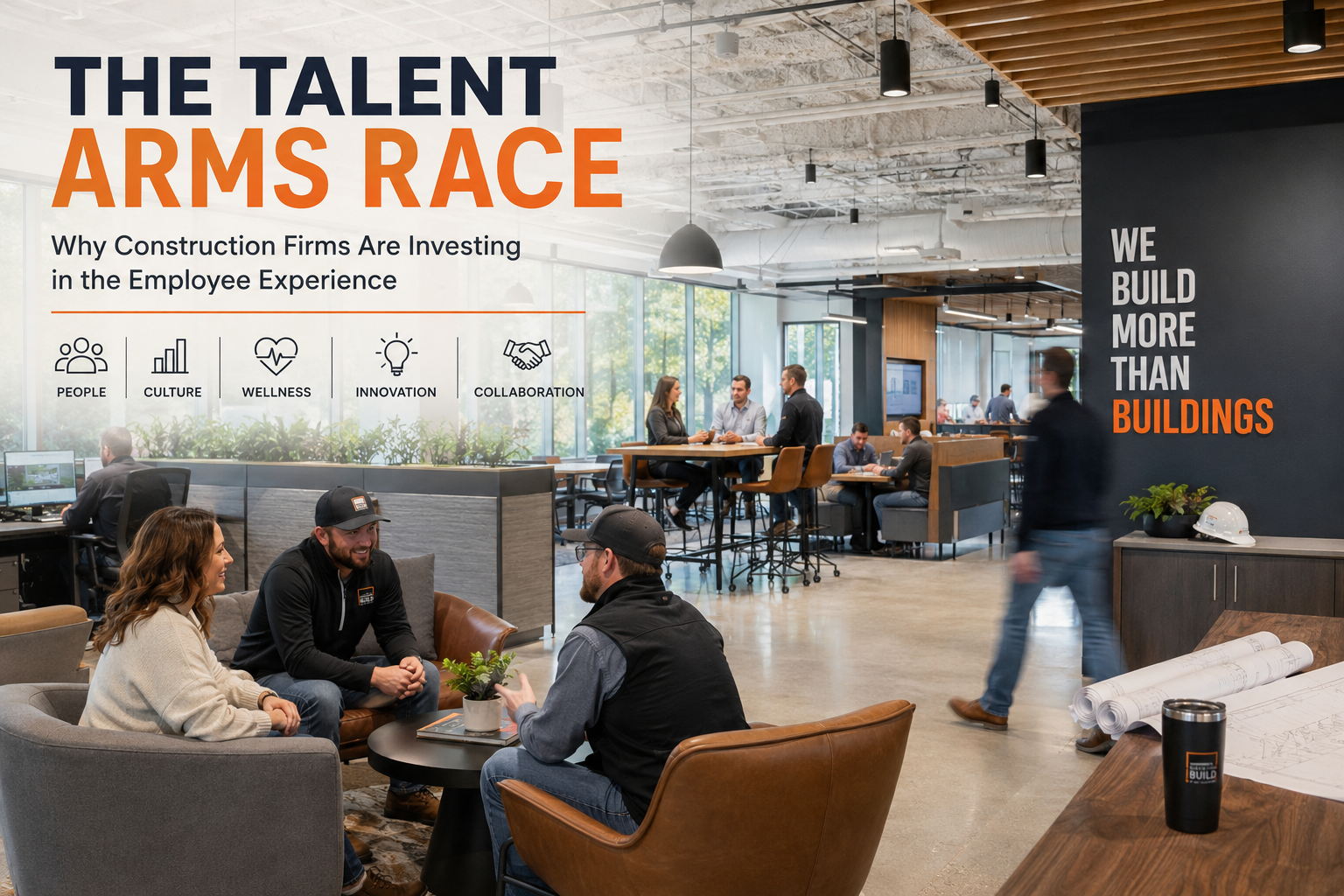
Modern construction firms are designing workplaces that encourage collaboration, mentoring, innovation, and relationship building. Comfortable gathering spaces, technology-enabled meeting rooms, wellness amenities, flexible work environments, and hospitality-inspired common areas are becoming more common as organizations seek to create destinations employees genuinely enjoy coming to.
The goal isn’t simply to create a beautiful office.
It’s to create a workplace that reflects the company’s values and culture.
More Than Design—It’s a Business Strategy
This evolution isn’t happening because companies are chasing the latest design trend.
It’s happening because the competition for talent has fundamentally changed.
Today’s workforce—particularly younger professionals—places a high value on collaboration, learning opportunities, wellness, purpose, and flexibility. While compensation remains important, many candidates also evaluate an employer by its culture and the environment in which they’ll spend their careers.
Forward-thinking contractors recognize that every office tour now serves two purposes: welcoming clients and recruiting future employees.
Increasingly, the workplace itself has become part of the interview process.
What We’re Seeing Across the Region
Many construction firms throughout the St. Louis market are embracing elements of this broader shift in different ways.
Some have invested in new headquarters designed to bring multiple business units together under one roof, encouraging collaboration and knowledge sharing. Others are enhancing training facilities, creating flexible work environments, expanding wellness initiatives, integrating advanced technology, or developing spaces that better support mentoring and professional growth.
Just as importantly, many organizations are investing in leadership development, internship programs, community engagement, employee ownership, and career advancement opportunities that reinforce a people-first culture.
While every company approaches these investments differently, the underlying objective is remarkably similar: attract exceptional people, help them grow, and create an environment where they want to stay.
A Trend Taking Shape Among Industry Leaders
Here in the St. Louis region, many respected contractors—including SLC3 members such as Clayco, PARIC, Alberici, KAI Design & Build, S. M. Wilson, Tarlton, and The Korte Company—have demonstrated, each in their own way, a commitment to investing in their people through leadership development, innovation, collaborative work environments, technology, wellness, and company culture.
Although each organization’s approach is unique, together they reflect a broader industry movement that recognizes employees as a company’s greatest competitive advantage.
The emphasis may look different from one firm to another, but the direction is clear.
Construction companies are investing in people with the same intentionality they’ve always invested in projects.
What This Means for the Industry
For owners, architects, engineers, specialty contractors, and suppliers, this trend is likely to influence much more than office design.
It will shape recruiting strategies.
It will influence project delivery.
It will affect how teams collaborate across disciplines.
And ultimately, it may determine which organizations are best positioned to attract the next generation of construction professionals.
The industry’s workforce challenges aren’t going away anytime soon.
Neither is the competition for great people.
Looking Ahead
One thing is becoming increasingly clear.
The construction industry’s next competitive advantage won’t be measured solely by backlog, technology, or equipment.
It will also be measured by the experience companies create for the people who make every project possible.
As our region continues to grow and new opportunities emerge, the firms that invest in their employees—through culture, leadership, learning, wellness, and thoughtful workplaces—will be well positioned to build not only remarkable projects, but remarkable careers.
At SLC3, we’ll continue watching this evolution because one of the most important projects underway in our industry isn’t being built on a jobsite.
It’s being built within the organizations themselves.