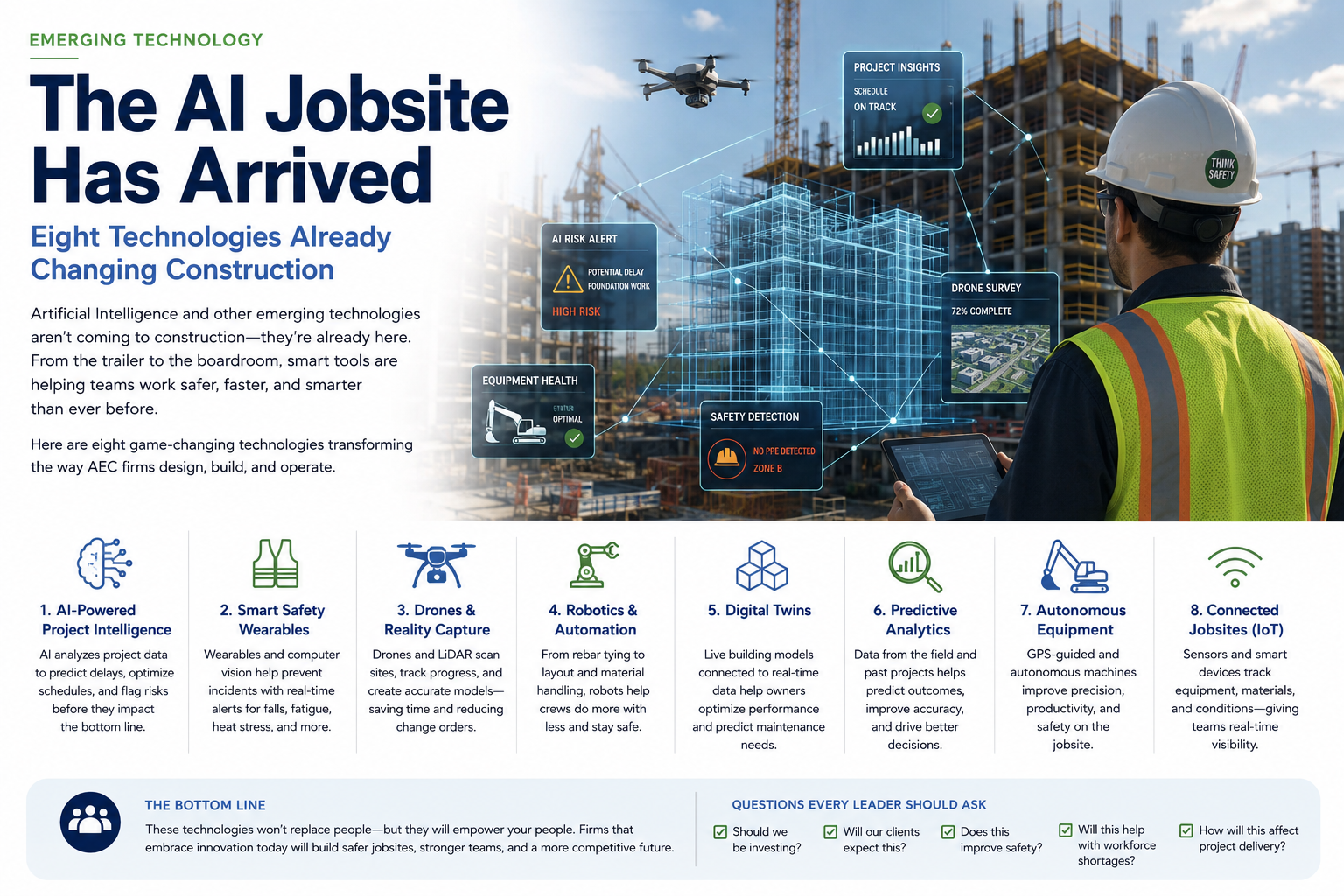
Eight Technologies Already Changing Construction
Artificial intelligence has quickly become one of the hottest topics in business, but in the architecture, engineering, and construction (AEC) industry, the conversation has already moved beyond theory. AI and other emerging technologies are making their way from the office to the jobsite—helping teams work smarter, improve safety, reduce risk, and deliver better outcomes.
For many firms, the question is no longer if these technologies will impact their business. The question is how quickly they should begin adopting them.
Here are eight innovations that are already reshaping the future of construction.
1. AI-Powered Project Intelligence
Artificial intelligence is helping project teams analyze enormous amounts of data in seconds. From predicting schedule delays and identifying potential cost overruns to assisting with RFIs and project documentation, AI is becoming a valuable decision-support tool rather than simply another software platform.
Instead of reacting to problems after they occur, project teams can now identify risks before they become costly issues.
2. Smart Safety Wearables
Today’s hard hats and safety vests are becoming much more than personal protective equipment. Wearable technology can monitor worker fatigue, heat stress, falls, and even environmental hazards in real time.
These tools aren’t designed to monitor employees—they’re designed to send everyone home safely at the end of the day.
3. Drones & Reality Capture
Drones, laser scanning, and LiDAR technology are transforming how projects are documented.
Rather than relying solely on traditional site walks, project teams can quickly create highly accurate digital models, verify construction progress, compare work against plans, and capture existing conditions before renovation projects begin. The result is fewer surprises, reduced rework, and more informed decision-making.
4. Robotics & Automation
Labor shortages continue to challenge every corner of our industry. Robotics aren’t replacing skilled craftspeople—they’re helping them accomplish more.
Layout robots, autonomous surveying equipment, robotic rebar tying systems, and material-handling technologies are improving accuracy while allowing skilled workers to focus on tasks requiring experience, judgment, and craftsmanship.
5. Digital Twins
Building Information Modeling (BIM) revolutionized design coordination. The next evolution is the Digital Twin—a living digital model connected to real-time building data.
Owners can monitor equipment performance, energy consumption, maintenance schedules, and occupant comfort long after construction is complete, allowing facilities to operate more efficiently throughout their lifecycle.
6. Predictive Analytics
Construction has always generated enormous amounts of data. The difference today is that firms are beginning to use it.
Historical project information can now help predict staffing needs, equipment utilization, safety trends, procurement risks, and scheduling conflicts before they impact the project.
Better information leads to better decisions.
7. Autonomous Equipment
Heavy equipment is becoming smarter every year.
GPS-guided grading systems, machine-controlled earthmoving equipment, and autonomous technologies are improving precision while reducing waste, increasing productivity, and helping projects stay on schedule.
8. Connected Jobsites
The Internet of Things (IoT) is bringing the jobsite online.
Connected sensors can monitor equipment, track materials, measure environmental conditions, and provide project managers with real-time visibility into operations. These technologies help teams respond faster, improve logistics, and make more informed decisions throughout the project lifecycle.
The Human Advantage
One misconception about emerging technology is that it replaces people.
In reality, the most successful firms are using technology to empower their people.
Construction has always been—and always will be—a people business. Relationships, leadership, problem-solving, and collaboration remain the foundation of every successful project. Technology simply gives professionals better information and better tools to make those human skills even more effective.
As workforce challenges continue and project complexity increases, organizations that thoughtfully embrace innovation will be better positioned to compete, attract talent, and deliver greater value to clients.
Looking Ahead
Technology is evolving rapidly, and so is our industry. Over the coming months, we’ll explore many of these innovations in greater depth—from AI and robotics to digital twins and connected jobsites—helping SLC3 members understand not only what’s new, but what matters most.
Because the future of construction isn’t coming.
It’s already here.