INDUSTRY NEWS & UPDATE
One of the St. Louis region’s largest education construction programs is approaching an important milestone.
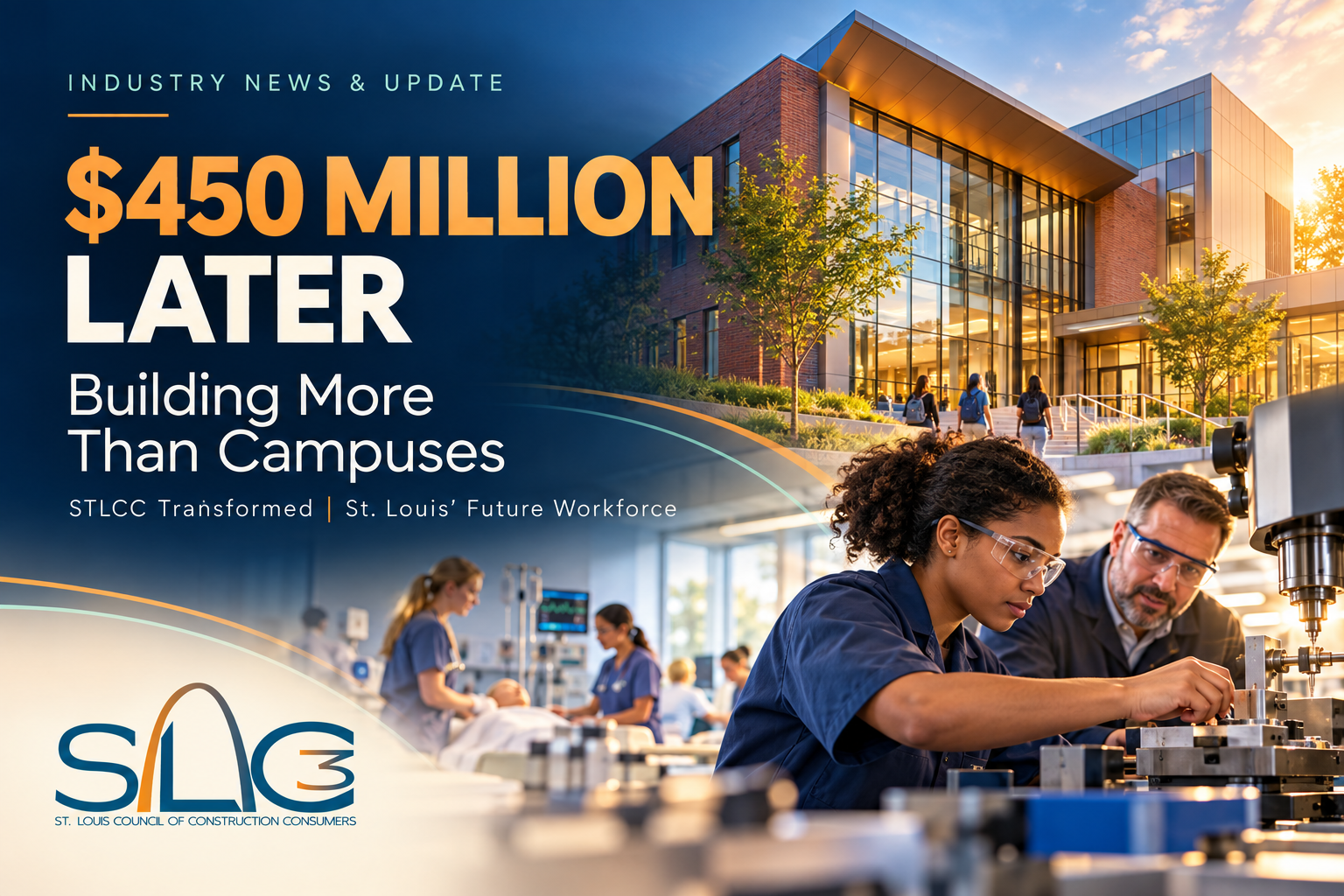
St. Louis Community College’s $450 million STLCC Transformed initiative is expected to reach completion in 2026, concluding a major capital program that has brought six new buildings along with renovations and improvements across the college’s four main campuses.
But the most important part of the story may not be the buildings themselves.
It is what many of those buildings were designed to produce: the next generation of St. Louis workers.
Construction Meeting Workforce Development
The STLCC Transformed program includes facilities dedicated to areas such as advanced manufacturing, nursing and health sciences, emerging technology, financial services and transportation.
That creates an unusual cycle of investment.
The construction industry helps build the facilities.
Those facilities train people for industries that will drive future economic growth.
And that growth creates the need for another generation of buildings and infrastructure.
For St. Louis, where employers across construction, manufacturing, healthcare and technology continue competing for skilled workers, the connection between physical infrastructure and workforce infrastructure is becoming increasingly difficult to separate.
Six Buildings, Multiple Growth Industries
The program includes:
- Advanced Manufacturing Center
- Nursing and Health Sciences Center
- Health Sciences and Technology Center
- Emerging Technology Center
- Financial Services Education Center
- Transportation Education Center
That list closely mirrors many of the sectors currently shaping regional investment.
Advanced manufacturing requires increasingly sophisticated technicians and facilities.
Healthcare continues to represent a significant construction and employment market.
Transportation is being transformed by new technologies.
And emerging technologies are changing virtually every industry, including architecture, engineering and construction.
The facilities where those skills are taught therefore become part of the region’s economic-development infrastructure.
What Owners Can Learn From Education Projects
There is also a broader lesson here for construction owners.
A capital program is most valuable when the building strategy connects directly to the organization’s long-term mission.
For a community college, that means asking more than, “What building do we need?”
It means asking:
What industries are growing?
What skills will employers need?
What equipment will students train on?
How flexible must laboratories and instructional spaces become?
How quickly could technology change?
And how can today’s capital investment remain useful years after construction is complete?
Those questions increasingly apply outside higher education as well.
Corporate owners, manufacturers, healthcare systems and public agencies are all trying to design facilities for organizations that may operate very differently ten years from now.
Buildings as Workforce Infrastructure
The St. Louis construction industry frequently talks about workforce shortages.
Understandably, much of that conversation focuses on recruiting people into the skilled trades.
But workforce development is a larger ecosystem.
The region needs electricians, carpenters, pipefitters and equipment operators. It also needs engineers, technicians, healthcare workers, manufacturing specialists, project managers and professionals capable of operating increasingly complex facilities.
Physical places where those people learn matter.
That is what makes the STLCC investment notable beyond its $450 million price tag.
The Next Construction Project May Begin in a Classroom
St. Louis is currently pursuing growth across advanced manufacturing, aerospace, healthcare, technology, infrastructure and other highly technical sectors.
Winning those investments requires sites, utilities, financing and buildings.
It also requires people.
As STLCC Transformed approaches completion, the program offers a reminder that construction and workforce development are not separate conversations.
Sometimes the facility being built today is where the workforce for tomorrow’s project will begin.