PROJECT SPOTLIGHT | MEDICAL CAMPUS CONSTRUCTION
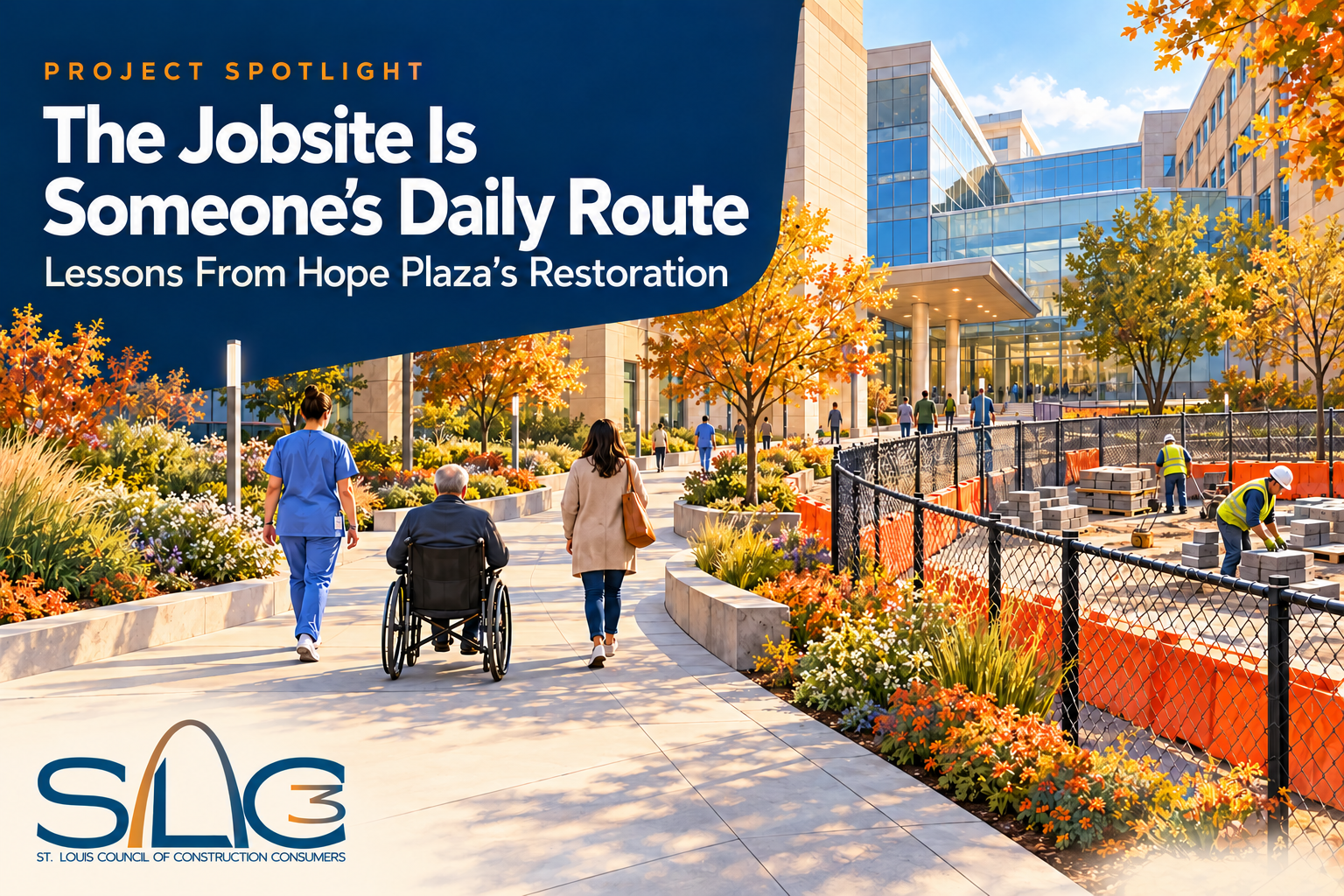
On a busy medical campus, a construction boundary can change someone’s entire route through the day.
WashU Medicine’s Ellen S. Clark Hope Plaza restoration provides a timely local example. A September facilities notice identifies work around the MetroLink platform, the west front entrance of the Eric P. Newman Education Center and sidewalks near Parkview Avenue.
The notice anticipates continued disruption and congestion at the Mid Campus Center circle through October. It also explains that weather and unforeseen field changes may require adjustments to work areas and phase dates.
Small Footprints, Significant Coordination
Exterior restoration may draw less attention than a new building, but its location can make coordination especially important.
At a medical campus, the area between buildings serves many users with different needs. An employee familiar with the campus may adapt quickly to a detour. A first-time visitor may need more guidance. A person with limited mobility may experience the same route change very differently.
WashU’s notice directs plaza users to south-side sidewalks at the Mid Campus Center circle and identifies later work at the MetroLink platform entrance and the University of Health Sciences and Pharmacy campus entrance.
The AEC takeaway is practical: pedestrian circulation deserves deliberate planning throughout a phased project.
Plan the Experience Around the Work
For teams undertaking comparable occupied-campus projects, useful planning questions include:
- Can people understand the alternate route? Review directions from the perspective of someone unfamiliar with the site.
- Who depends on each entrance? Include facilities staff and building users in discussions about access.
- Where do routes overlap? Examine the interaction between pedestrians, deliveries and construction activity.
- How will changes be communicated? Coordinate notices with the timing of each new phase.
- Who checks conditions in the field? Assign responsibility for reviewing temporary routes as work progresses.
These questions are broader project-delivery considerations, not a description of WashU’s construction procedures.
Communication Is Part of the Sequence
A phased schedule is useful only when affected users understand what it means for them.
The Hope Plaza notice pairs an explanation of the work with directions, anticipated disruption and a reminder that dates can change. That combination gives users information they can act on.
For Greater St. Louis’s healthcare, education and institutional construction community, the project is a reminder to evaluate success from both sides of the construction fence: the team completing the work and the people continuing to use the campus.