St. Louis redevelopment brings together historic preservation, advanced construction techniques, and the region’s growing bioscience industry.
A building with more than a century of history is being transformed into a center for scientific discovery in St. Louis.
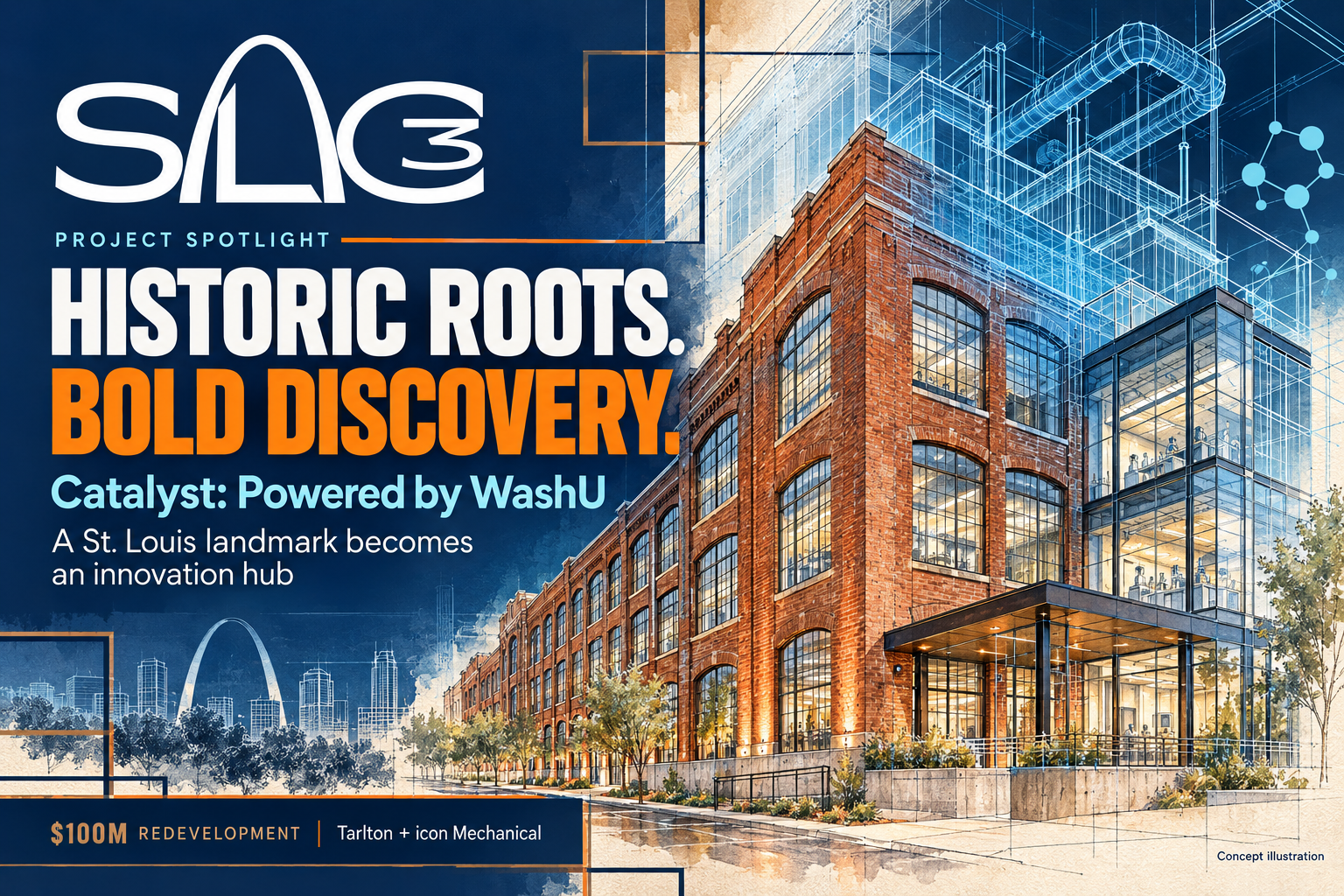
Catalyst: Powered by WashU, a $100 million, 163,000-square-foot redevelopment of the former MERS Goodwill building, is bringing new purpose to a historic structure while creating space for cutting-edge bioscience research and innovation.
The ambitious project brings together St. Louis construction firms Tarlton and icon Mechanical, whose teams are navigating the challenges of modernizing a century-old building while preserving its architectural character.
Preserving History While Building for the Future
Originally constructed in 1919 for Standard Sanitary Manufacturing Co., the building later served as a plumbing manufacturing and supply warehouse before becoming home to MERS Goodwill from 1944 to 2019.
Today, developer BOBB LLC, an affiliate of Washington University, is leading its transformation into a modern research and innovation facility.
The redevelopment is particularly complex because of the building’s historic structure, limited construction footprint, and the specialized infrastructure required for laboratory operations.
Tarlton’s crews have installed new foundations as deep as 12 feet below the existing structure, carefully threading drilled piers and grade beams around original foundations.
The project also includes restoration of original brickwork, replacement of industrial windows, structural reinforcement, and a new addition featuring a landscaped courtyard and pedestrian-friendly gathering spaces.
Technology Meets Construction Expertise
To address the challenges of working within an existing historic structure, Tarlton and icon Mechanical have incorporated advanced construction technologies.
Key construction innovations include:
- 3D laser scanning and modeling: Creating detailed digital representations of existing conditions to identify potential conflicts before construction.
- Building Information Modeling (BIM): Coordinating structural and mechanical systems within the building’s confined spaces.
- Reality capture technology: Helping project teams validate installation conditions and improve accuracy.
- Off-site prefabrication: Allowing mechanical components and ductwork to be assembled in advance, reducing congestion and improving installation efficiency.
These approaches demonstrate how digital coordination and collaborative planning can help construction teams overcome the unique challenges of adaptive reuse projects.
Creating Space for Scientific Discovery
One of the project’s most significant tenants will be C2N Diagnostics, a St. Louis-based biotechnology company focused on advancing diagnostic testing for Alzheimer’s disease.
C2N plans to occupy approximately 82,451 square feet across the building’s first three floors, establishing its corporate headquarters and expanding its laboratory operations.
The facility will include specialized mechanical and ventilation systems designed to support sophisticated research and laboratory functions.
Beyond C2N, Catalyst is designed to attract additional biotechnology companies, researchers, and emerging startups, strengthening connections between Washington University and the broader St. Louis innovation community.
Investing in People and Partnerships
The project also reflects the importance of workforce development and collaboration within the construction industry.
icon Mechanical provided hands-on experience to apprentices participating in the UA Local 562 Champion Program and partnered with certified women-owned businesses, including Thornburg Insulation and Fire Stop Tech.
These partnerships highlight the role major construction projects can play in developing skilled talent and creating opportunities for specialized trade partners.
A New Chapter for a St. Louis Landmark
With completion and initial tenant occupancy scheduled for late 2026, Catalyst represents more than the renovation of a historic building.
It demonstrates how thoughtful redevelopment, innovative construction methods, and collaboration across the industry can preserve St. Louis’s architectural heritage while creating infrastructure for the next generation of scientific discovery.
Source: Construction News and Review, Q4 2026, “Tarlton, icon Mechanical Transform Victorian-Era Building into Catalyst: Powered by WashU,” by Tiffanie Reynolds, page 42.