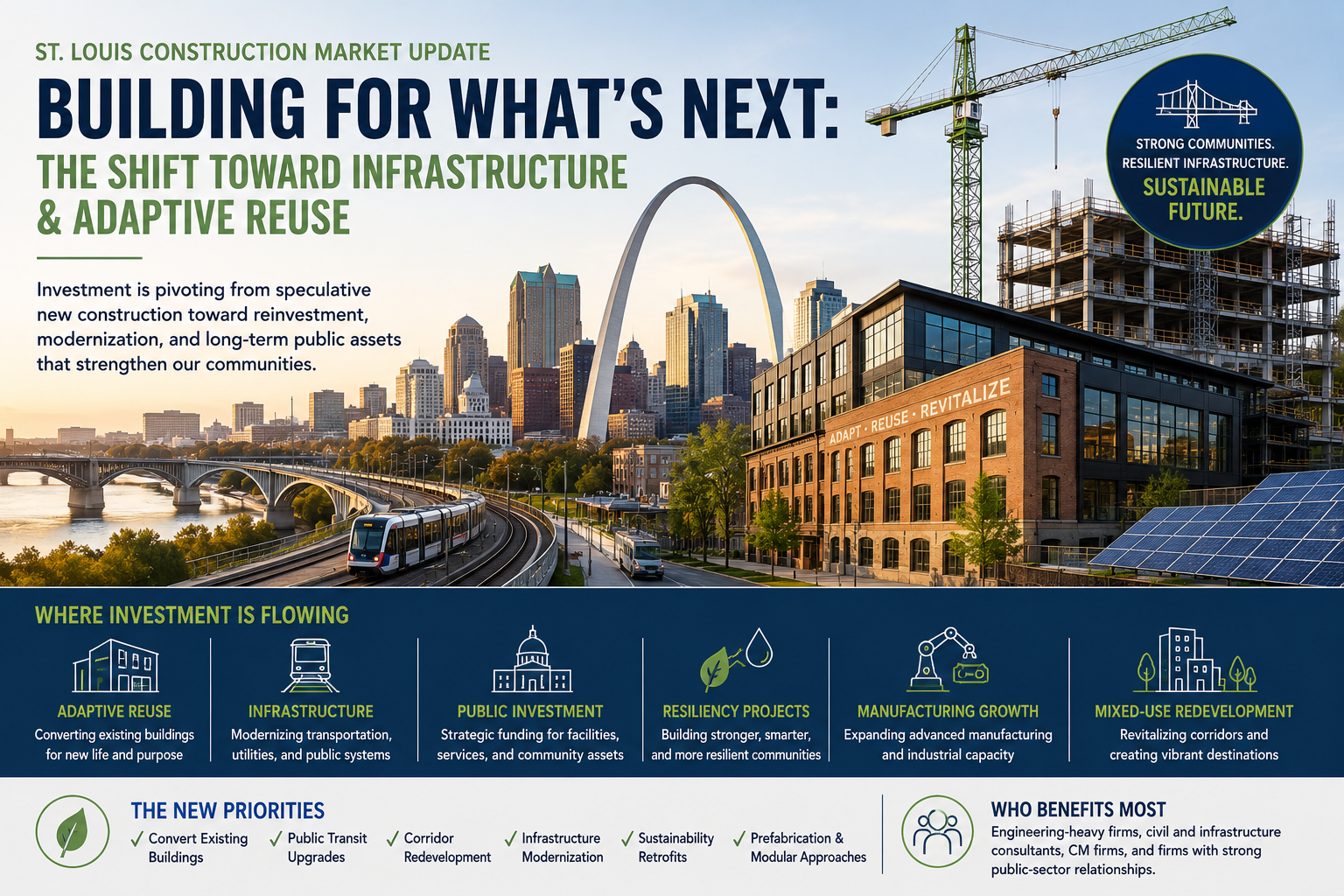
As the St. Louis design and construction market enters a more cautious phase, one trend is becoming increasingly clear: the industry is pivoting away from speculative new construction and toward infrastructure, adaptive reuse, and publicly supported redevelopment.
While commercial office development and some institutional sectors have begun to soften, investment continues to flow into projects tied to long-term public needs, resiliency, manufacturing growth, and modernization of existing assets.
For many firms across the region, this shift is reshaping where opportunities are emerging—and which teams are best positioned to compete.
From Expansion to Reinvestment
Over the past decade, much of the market’s momentum centered around new development: corporate campuses, healthcare expansions, educational facilities, mixed-use districts, and commercial growth.
Today, however, rising financing costs, economic uncertainty, and changing space utilization patterns are causing owners to reconsider how they invest capital.
Instead of building entirely new facilities, many organizations are focusing on:
- renovating and repositioning existing buildings
- extending the life of infrastructure assets
- improving operational efficiency
- modernizing aging systems
- pursuing phased redevelopment strategies
This transition reflects a broader national movement toward reinvestment rather than expansion.
Adaptive Reuse Gains Momentum
One of the strongest growth areas emerging in St. Louis is adaptive reuse—the conversion and modernization of existing structures for new purposes.
Former office buildings, industrial facilities, warehouses, and underutilized commercial properties are increasingly being evaluated for:
- residential conversion
- mixed-use redevelopment
- innovation hubs
- healthcare outpatient use
- hospitality and entertainment
- workforce housing
Adaptive reuse has become attractive for several reasons:
- lower land acquisition costs
- sustainability goals
- historic preservation incentives
- reduced entitlement timelines
- demand for urban revitalization
Nationally, cities are increasingly viewing adaptive reuse as both an economic development strategy and a sustainability initiative.
In St. Louis, redevelopment activity continues to expand along major corridors and urban districts where infrastructure already exists and revitalization efforts are supported through public-private partnerships.
Infrastructure Spending Remains Strong
While some private development sectors have slowed, infrastructure spending continues to provide stability throughout the region.
Large-scale investment remains active in:
- aviation
- transportation
- water and wastewater systems
- utilities
- flood mitigation
- roadway modernization
- public facilities
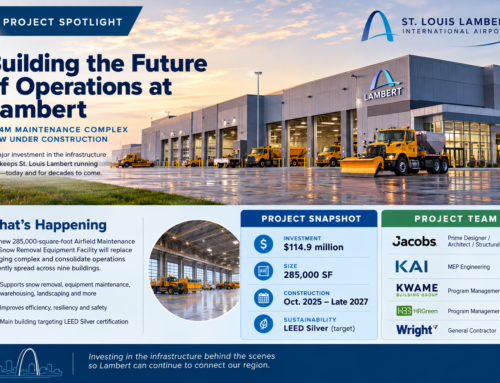
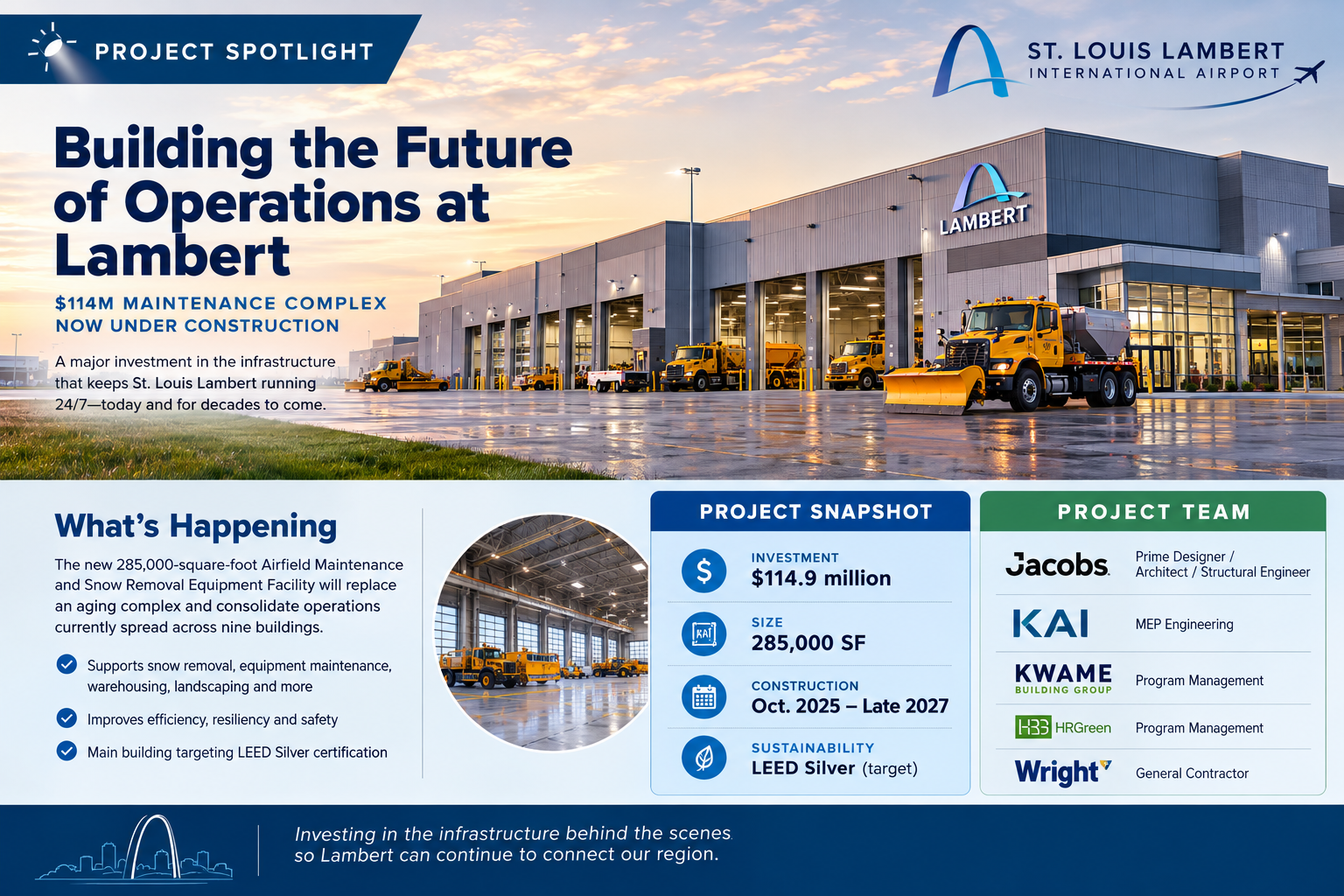
Projects such as the Lambert Airport modernization program and ongoing utility improvements demonstrate that public-sector and infrastructure-related work remains one of the strongest drivers of regional construction activity.
Federal infrastructure funding has also created longer-term momentum for:
- resiliency planning
- transit-oriented development
- corridor improvements
- sustainability upgrades
- civil infrastructure expansion
For engineering and infrastructure-focused firms, this sector may continue to offer consistent opportunities even as portions of private development moderate.
Sustainability & Resiliency Become Priorities
Another defining trend is the growing emphasis on resiliency and sustainability retrofits.
Owners are increasingly prioritizing:
- energy-efficient building systems
- HVAC modernization
- stormwater improvements
- building envelope upgrades
- electrification initiatives
- resiliency planning
- decarbonization strategies
In many cases, these projects are being driven not only by environmental goals, but also by operational cost savings and long-term asset management planning.
Rather than pursuing entirely new construction, many institutions are investing in extending and modernizing existing facilities.
Modular & Prefabrication Approaches Expanding
As labor shortages and cost pressures continue to affect the industry, more firms are exploring:
- prefabrication
- modular construction
- off-site manufacturing
- accelerated delivery methods
These approaches are gaining traction in sectors where speed, predictability, and labor efficiency are increasingly important.
Healthcare, multifamily housing, manufacturing, and infrastructure-related projects are among the sectors most actively exploring these methods.
Who Benefits from the Shift?
This evolving market environment tends to favor firms with strong technical, infrastructure, and public-sector expertise.
The firms likely to see the strongest positioning include:
- engineering-heavy design firms
- civil and infrastructure consultants
- construction management firms
- firms with government and public-sector relationships
- firms experienced in phased renovations and redevelopment
- teams with sustainability and resiliency expertise
By contrast, firms heavily dependent on speculative commercial development or large-scale new institutional expansion may face increased competition and longer pursuit timelines.
A Market Defined by Strategic Investment
The St. Louis construction market is not slowing uniformly—it is reallocating.
Investment is increasingly flowing toward projects tied to:
- public infrastructure
- long-term resiliency
- redevelopment
- modernization
- operational efficiency
- manufacturing growth
For the design and construction industry, the next several years may be defined less by rapid expansion and more by strategic reinvestment in existing assets and critical infrastructure systems.
The firms that adapt to that reality may be best positioned for the next cycle of growth.
Supporting Industry & Market References
National & Regional Indicators
- American Institute of Architects (AIA) Consensus Construction Forecast
- Engineering News-Record (ENR Midwest) regional market reporting
- Federal Infrastructure Investment and Jobs Act (IIJA) funding impacts
- Urban Land Institute (ULI) redevelopment and adaptive reuse trends
Key Market Drivers
- Higher interest rates are reducing speculative development
- Increased focus on public-sector capital investment
- Demand for sustainable redevelopment
- Infrastructure modernization funding
- Growing emphasis on resiliency planning
Regional Project Types Supporting the Shift
- Airport modernization
- Water and wastewater infrastructure
- Urban corridor redevelopment
- Adaptive reuse conversions
- Manufacturing expansion
- Transit and mobility improvements
by: Kelly Jackson, SLC3 Executive Director