Every generation believes it is living through unique challenges.
In many ways, that’s true.
Today’s parents are balancing demanding careers, rising childcare costs, constant digital connectivity, and a world that seems to expect them to be everywhere, all at once. Those pressures are real.
But lately I’ve noticed something else happening.
Too often, conversations become less about solving problems and more about proving that this generation has it harder than every generation before it.
As someone from Generation X—and now part of the growing grandparent generation—I respectfully disagree.
Not because life is easy today.
But because hardship has never belonged to one generation.
We Didn’t Have It Easy Either
Many of us raised children while working full-time.
We rushed from daycare pickups to soccer practices. We packed lunches before sunrise, attended school programs during lunch breaks, and somehow still managed to show up for early morning meetings.
We weren’t offered remote work.
There were no grocery delivery apps.
There were no smartphones reminding us about every appointment.
If you forgot something, you turned around and drove back.
Many mothers returned to work only weeks after having babies because there simply wasn’t another option. And in my case, there was no Adoptive Parent Leave. Fathers were often expected to work long hours with little flexibility. We quietly navigated comments, biases, and expectations that would likely never be acceptable today.
We weren’t superheroes.
We were simply doing what every generation has always done—adapting.
The Difference Wasn’t Easier Circumstances
It was perspective.
When something was inconvenient, we generally viewed it as part of life rather than evidence that the system should immediately change.
That didn’t mean we enjoyed every sacrifice.
It meant we accepted that adulthood often requires competing priorities.
Sometimes you attended the meeting.
Sometimes you missed the baseball game.
Sometimes you left work early.
Sometimes you couldn’t.
None of those decisions made you a bad parent.
They simply made you human.
Every Generation Changes the Workplace
One of the greatest strengths Millennials have brought to the workplace is the willingness to question outdated practices.
Because of them, conversations around mental health, flexibility, work-life balance, and parental involvement have become healthier.
For that, I genuinely give them credit.
Many of us in Generation X wanted more balance too—we just didn’t feel we had permission to ask for it. Asking to work from home, requesting flexible schedules, or putting family ahead of work often came with a price. We risked being laughed at, scolded, overlooked for promotions, or simply labeled as someone who wasn’t committed enough. We learned to keep our heads down and make it work.
Thankfully, younger generations challenged many of those assumptions, and workplaces are healthier because they did.
That’s progress.
But progress can become entitlement if we lose sight of another truth:
The world cannot always rearrange itself around our individual circumstances.
Organizations still have missions.
Clients still have deadlines.
Construction projects still start at sunrise.
Hospitals still operate 24 hours a day.
Someone still has to be there.
The healthiest workplace is one that offers flexibility while also recognizing that responsibility, reliability, and teamwork never go out of style.
What We Hope Doesn’t Get Lost
The greatest lesson many grandparents hope to pass along isn’t about working harder.
It’s about resilience.
Showing up when it’s inconvenient.
Keeping commitments.
Finding solutions before finding excuses.
Doing difficult things without assuming life is being unfair.
Understanding that not every opportunity will fit perfectly into your schedule.
And realizing that sometimes the very opportunities that grow your career require sacrifice.
Many of us attended early meetings because those were the rooms where relationships were built.
We volunteered.
We served on committees.
We stayed late.
Not because we had extra time—but because we believed investing in our profession would eventually benefit our families.
Often, it did.
Wisdom Travels Both Directions
The younger generation has much to teach us.
Technology.
Efficiency.
Flexibility.
The importance of mental well-being.
Older generations have something equally valuable to offer.
Perspective.
Patience.
Resilience.
The ability to weather seasons that are difficult without assuming they will last forever.
Perhaps the goal isn’t deciding which generation had it harder.
Perhaps the better question is this:
What can each generation learn from the other?
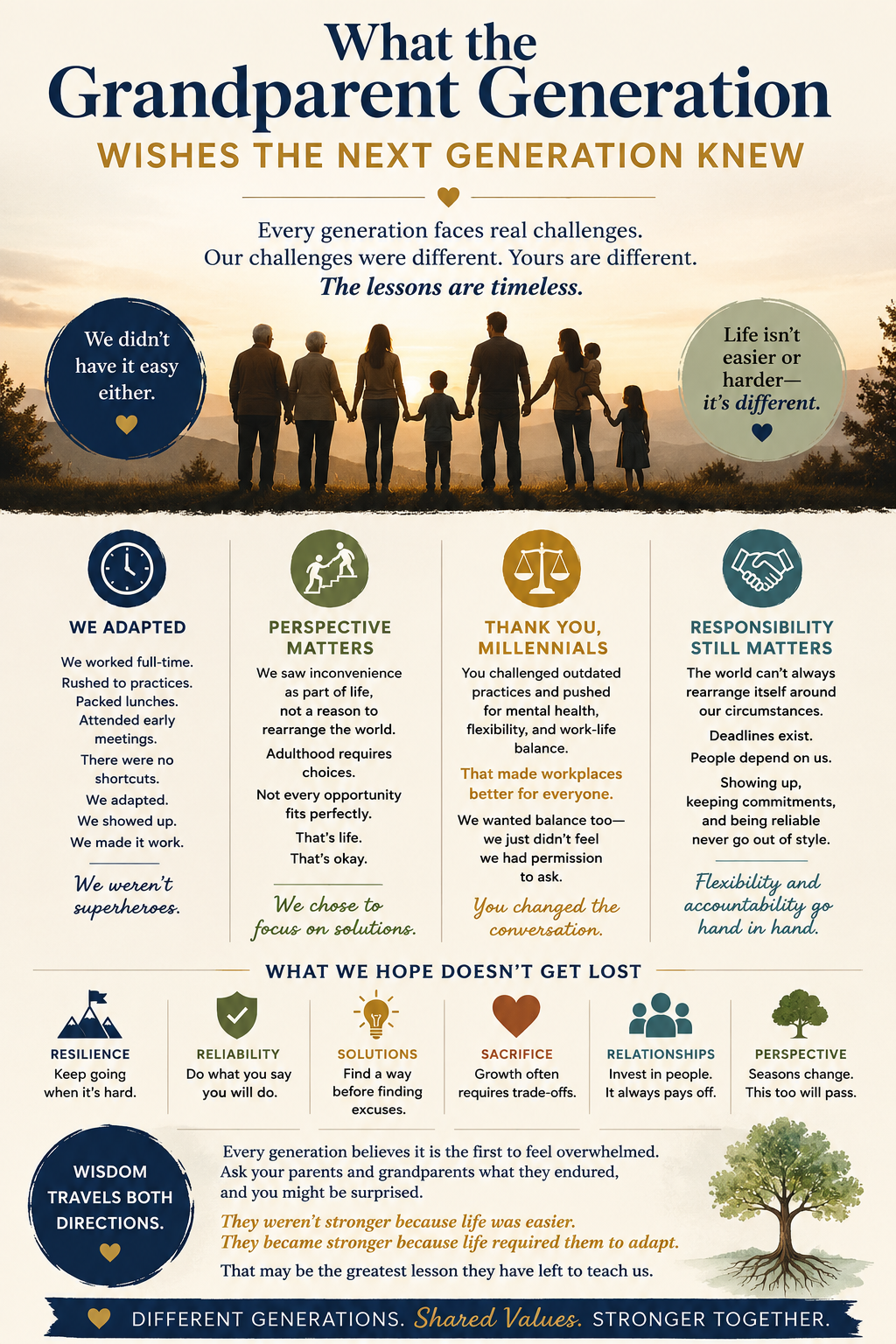
Perhaps every generation believes it is the first to feel overwhelmed. But if we took the time to ask our parents and grandparents what they endured, we might discover something surprising. They weren’t stronger because life was easier. They became stronger because life required them to adapt. That may be the greatest lesson they have left to teach us.
Because every generation inherits the work of those before it.
And every generation has a responsibility to leave something worthwhile for those who follow.
The strongest workplaces—and the strongest families—aren’t built when one generation believes it has all the answers.
They’re built when each generation has enough humility to become both teacher and student.