A major structural scare in Midtown Manhattan is putting a national spotlight on a topic that matters far beyond New York: what happens when older buildings are asked to do new things.
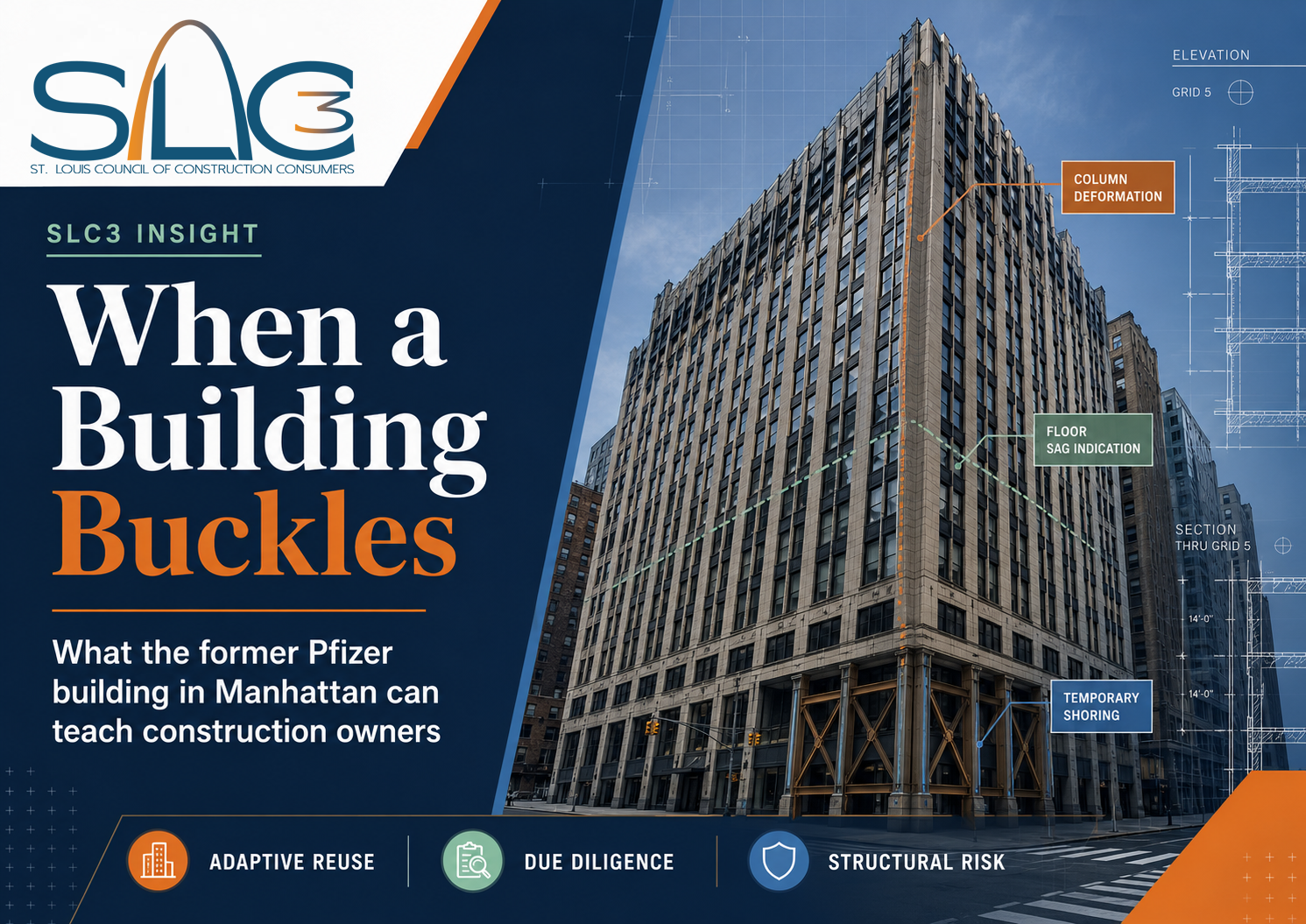
Earlier this month, the former Pfizer headquarters at 235 East 42nd Street was evacuated after two load-bearing columns buckled during a large office-to-residential conversion project. According to industry reporting, the issue occurred around the 21st floor, where officials also reported cracked structural elements and sagging floors. Emergency crews, engineers, and city officials responded quickly, evacuating the site and nearby buildings while temporary shoring was installed to stabilize the structure. No injuries were reported.
The project itself is significant. The former Pfizer complex is being transformed into one of the largest office-to-residential conversions in the country, with plans for more than 1,600 apartments and a major vertical expansion. For many cities, projects like this represent an appealing solution to two challenges at once: underused office buildings and the need for more housing.
But the Manhattan incident is a reminder that adaptive reuse is never as simple as changing the label on a building.
The lesson: existing buildings require extraordinary due diligence
For SLC3 members, the lesson is not that office conversions are unsafe. The lesson is that existing buildings come with existing unknowns.
When a new building is designed from the ground up, the team controls the assumptions from the beginning. With adaptive reuse, renovation, expansion, or repositioning, the project team inherits decades of prior decisions: original construction methods, past renovations, undocumented field changes, aging materials, deferred maintenance, and building systems that may no longer match today’s intended use.
That does not make reuse a bad idea. In fact, adaptive reuse can be smart, sustainable, and economically necessary. It can preserve valuable structures, reduce demolition waste, and bring new life to urban cores. But it does mean owners, architects, engineers, contractors, and inspectors must treat the discovery phase as mission-critical—not optional.
Engineering News-Record reported that investigators will likely review original drawings, shop drawings, modification plans, load calculations, construction sequencing, photographs, field conditions, and contractor records to determine what happened in Manhattan. Experts also cautioned that the cause may not be limited to one factor; it could involve design assumptions, construction sequencing, field modifications, temporary loading, or some combination of those elements.
That is the practical takeaway for owners: risk often hides in the gap between what the drawings say, what the building actually is, and what the construction process temporarily asks the structure to carry.
Temporary conditions still matter
One of the most important reminders from this incident is that construction-phase conditions matter just as much as the finished design.
A building may be perfectly capable of supporting its final intended use, but still be vulnerable during demolition, material staging, selective removals, structural transfers, or temporary loading. Construction Dive noted that experts raised several possible contributors that investigators may consider, including whether materials were stacked in areas not designed for heavy load or whether structural elements may have been altered during the work.
For SLC3 members, that reinforces the importance of asking hard questions early:
Has the existing structure been field-verified?
Do the original drawings match reality?
Has the team reviewed temporary construction loads, not just final loads?
Is there a clear shoring and sequencing plan?
Who has authority to stop work if something looks wrong?
How are concerns elevated from the field to the design team and owner?
These questions are not just technical details. They are owner-protection questions. They affect safety, schedule, cost, liability, public perception, and trust.
Will we see more of this?
We will likely see more adaptive reuse, more office conversions, and more complex renovation work—not necessarily more structural failures.
Across the country, cities are looking at underused office buildings differently. Hybrid work patterns, office vacancy, housing shortages, and sustainability goals have all pushed owners and public officials to reconsider what existing buildings can become. The Associated Press reported that office-to-apartment conversions have become increasingly popular as cities work to address housing needs and underused office space.
That trend is relevant in St. Louis, too. Brookings has reported that downtown St. Louis continues to face significant office vacancy, with a small number of highly vacant buildings accounting for a large share of the challenge. For our region, adaptive reuse will continue to be part of the conversation around downtown vitality, economic development, housing, preservation, and long-term building value.
But as more projects move in that direction, the standard for planning must rise with the complexity of the work.
Adaptive reuse is not a shortcut. It is a specialized discipline. It requires strong coordination between owners, engineers, architects, contractors, inspectors, code officials, and specialty consultants. It also requires realistic budgets and schedules that leave room for investigation, testing, documentation, peer review, and field-driven problem solving.
The SLC3 takeaway
For construction consumers, the former Pfizer building is not just a dramatic headline. It is a case study in why informed ownership matters.
Owners set the tone for the project. They determine whether due diligence is valued or rushed. They decide whether the team has the time, budget, and authority to investigate before acting. They influence whether safety concerns are treated as obstacles or as essential information.
The strongest project teams are not the ones that assume everything will go according to plan. They are the ones that build systems for what happens when reality does not match the plan.
As St. Louis continues to evaluate aging buildings, vacant properties, historic assets, and redevelopment opportunities, this moment offers an important reminder: the future of construction is not only about building new. It is also about understanding what we already have.
And when we ask old buildings to serve new purposes, we owe them—and the people who will work in, live in, and move around them—the respect of doing the work carefully.