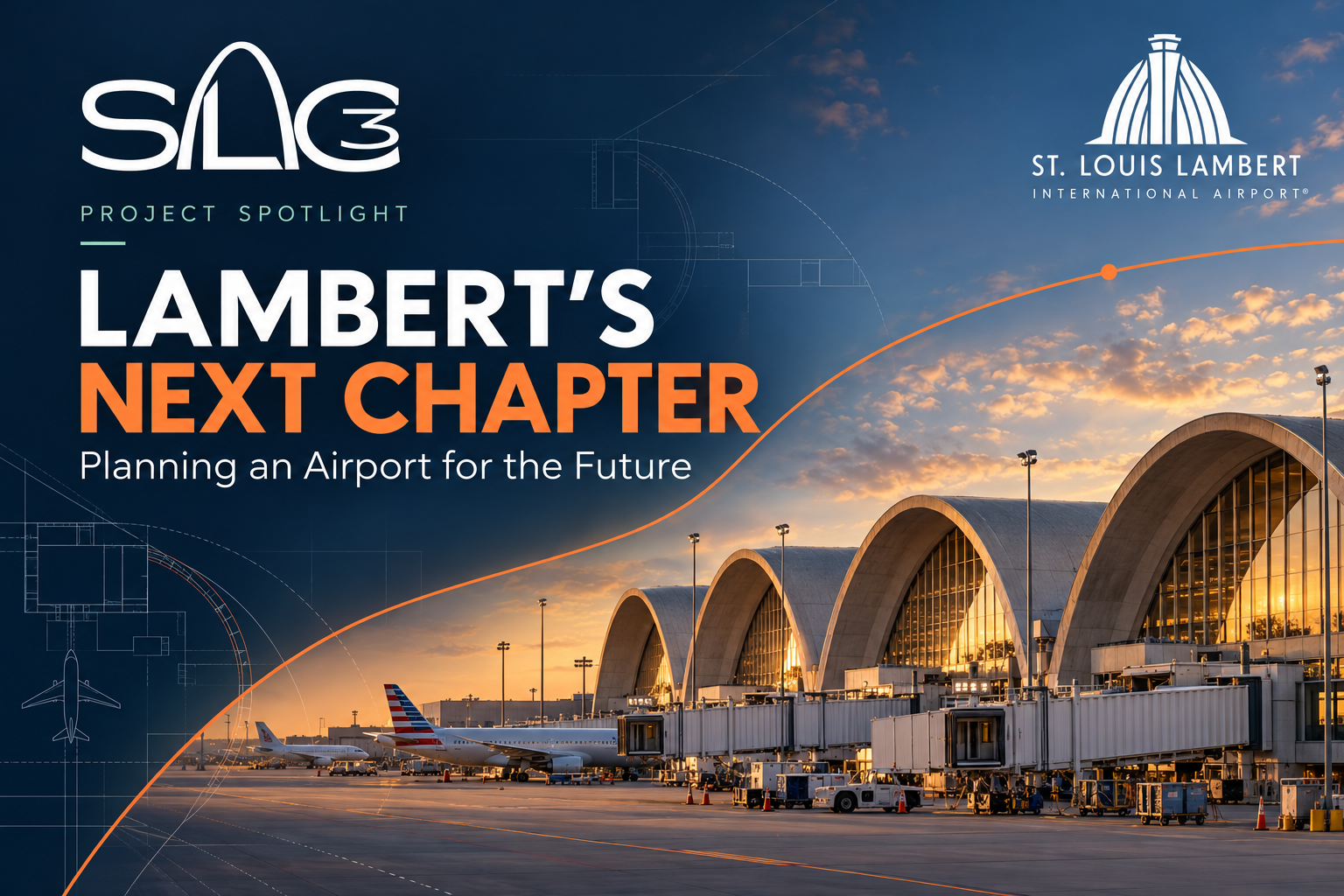
PROJECT SPOTLIGHT | ST. LOUIS LAMBERT INTERNATIONAL AIRPORT
An airport transformation begins long before travelers step into a new concourse. It starts with decisions about capacity, infrastructure, operations and how to build for the future while keeping an essential transportation hub moving.
At St. Louis Lambert International Airport, an SLC3 owner member, those decisions are shaping the proposed Consolidated Terminal Program, a major modernization effort intended to bring passenger operations into a single terminal complex.
For the region’s architecture, engineering and construction community, the project offers a look at the coordination behind transforming a working airport.
More Than a New Terminal
Lambert’s proposed transformation reaches well beyond the spaces passengers see at their gates.
The airport’s planning materials and design solicitation identify a connected program of improvements, including:
- A renovated terminal and new concourse with gates on both sides
- A centralized security screening checkpoint
- A new federal inspection facility for international arrivals
- An all-new baggage system and updated building systems
- Reconfigured roadways, an improved entrance and expanded parking
Together, these elements address passenger circulation, aging facilities, operational reliability and the infrastructure needed to support a modern airport.
Each component also affects the others. Roadway design influences access to the terminal. Security and baggage systems shape the building’s layout. Gate placement affects aircraft operations and the distance passengers walk.
From a project-delivery perspective, that interdependence makes early coordination essential.
Balancing Vision and Affordability
Lambert’s planning process also illustrates a challenge familiar to construction owners: aligning a long-term vision with the cost of delivering it.
In July, First Alert 4 reported that the project team was refining the proposed terminal design after reaching the 30% design milestone. Rising construction costs prompted a review with airline partners, designers and construction teams, including reconsideration of the original proposal for up to 62 gates.
The reporting also described plans for wider concourses, larger gate-holding areas and additional food, beverage and retail space, while retaining the ability to expand in the future.
For owners and project teams, this presents a useful planning question: What should a facility deliver at opening, and how can its design accommodate future needs?
Decisions made during design can influence operating costs, maintenance requirements, user experience and the practicality of later expansion. Lambert’s evolving proposal provides a local example of those considerations coming together on a substantial scale.
Modernizing a Working Airport
Airport construction adds another layer of complexity: the facility must continue serving travelers, airlines and employees throughout the work.
As a project-delivery consideration, that means evaluating how construction phases interact with passenger access, ground transportation, utilities, security and airfield operations. Temporary arrangements and transitions deserve the same careful coordination as the finished facility.
The broader lesson for the AEC community is applicable to hospitals, manufacturing plants, campuses and other occupied facilities: successful modernization depends on understanding how the owner operates and incorporating those needs into the delivery plan.
A Long-Term Project to Follow
Lambert’s FAA-approved 2023 Master Plan establishes a framework for long-term airport development. However, the airport notes that the proposed consolidated terminal and west airfield projects still require airline agreements, funding approvals, and state and local permits. The master plan itself does not guarantee that every proposed project will proceed.
That distinction makes Lambert a project worth following through its planning and design milestones.
For SLC3 members, its next chapter brings several central industry issues into focus: modernizing aging infrastructure, coordinating complex systems, managing cost and designing facilities that can adapt over time.
The work taking shape today will help determine how St. Louis welcomes travelers and supports regional connections for years to come.
Learn more: Explore Lambert’s on-airport development plans.