What if the greatest act of tolerance isn’t agreeing with someone—but choosing to understand them?
Over the weekend, I listened to Dr. Robert Jeffress speak about the meaning of true tolerance. It challenged me to think about something I see becoming increasingly common in our relationships, workplaces, organizations, and communities.
Ironically, we live in a culture that talks constantly about tolerance while practicing very little of it.
Today’s version of tolerance often comes with conditions. We expect others to respect our opinions, beliefs, and preferences, yet we can be quick to dismiss, criticize, or reject perspectives that differ from our own.
But that isn’t tolerance.
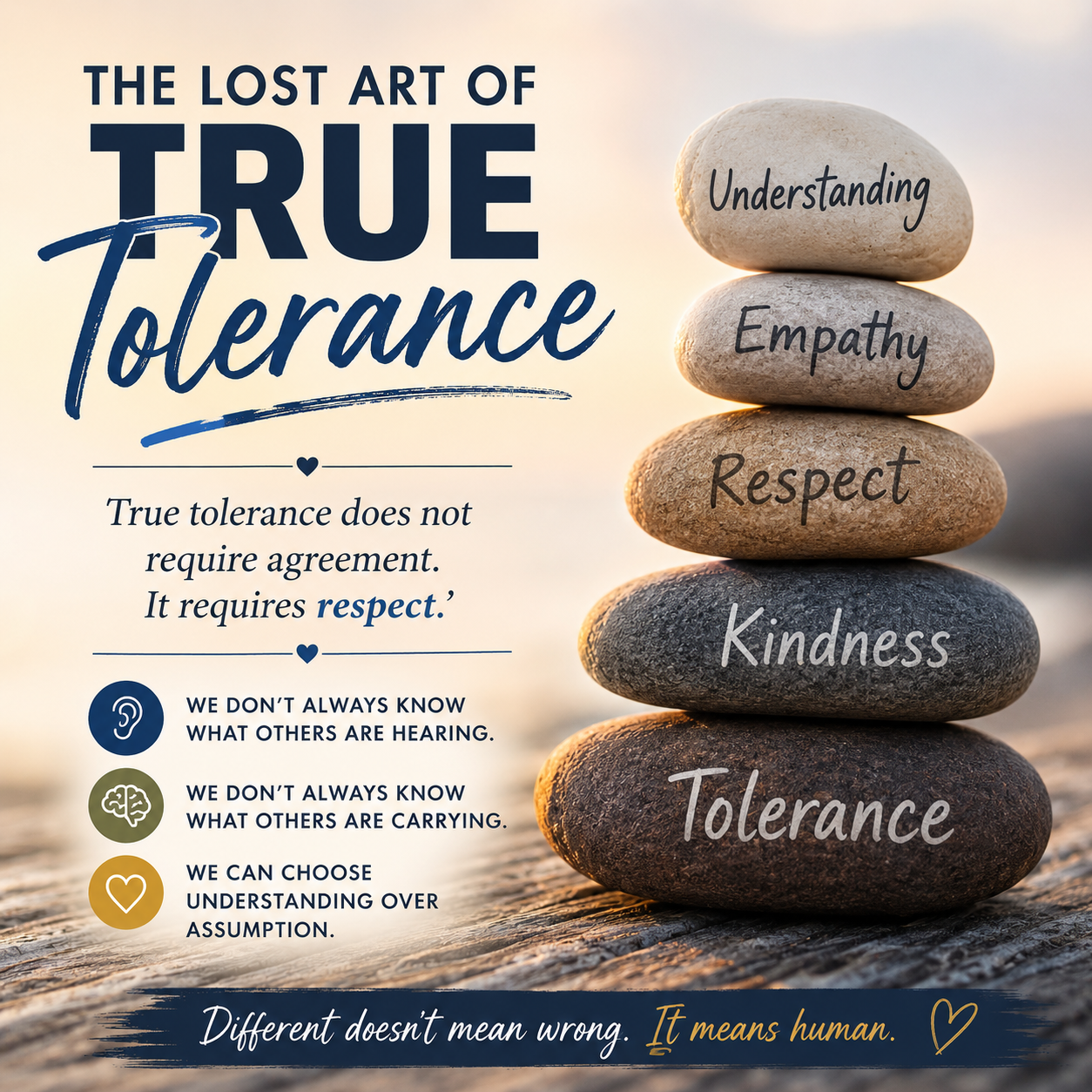
True tolerance does not require agreement. It requires respect.
It means being able to say, “That isn’t for me,” without feeling compelled to attack, ridicule, or diminish someone else’s experience. It recognizes that people can hold different beliefs, come from different backgrounds, process information differently, and still deserve dignity and kindness.
How Assumptions Create Division
Recently, I experienced something that reminded me just how easily misunderstandings happen.
Through a side job, I interact with people in a fast-paced online environment. During one conversation, I struggled to understand someone’s username. The spelling and pronunciation were unfamiliar, and the conversation was moving quickly. As I tried to process what I was seeing and hearing, I apparently made a facial expression that the other person interpreted as hurtful.
The reality couldn’t have been more different.
My expression wasn’t a reaction to her explanation. I was simply concentrating, trying to understand what I was reading.
When I learned she had been hurt, I immediately apologized and explained what had happened because causing offense was never my intention.
That interaction left me asking an important question:
How often do we misinterpret one another?
How many strained relationships begin with an incorrect assumption?
How many workplace conflicts start because someone misunderstood an email, a facial expression, a delayed response, or a brief comment?
How many times do we assign negative intent when none actually existed?
The Things We Cannot See
My own experiences have shaped how I view these situations.
As a child, I suffered significant hearing damage in both ears. I required speech therapy and special accommodations throughout school. Even today, I process conversations differently. I often need a little more time to absorb what I hear and read before responding thoughtfully.
I also live with ADHD. The combination of hearing impairment and attention challenges means processing conversations sometimes requires extra effort. What others may interpret as hesitation, confusion, or disinterest is often simply my brain working hard to understand everything being communicated.
Because of that, I’ve learned an important truth:
Not everything is about us.
Sometimes the person who didn’t respond immediately is still processing.
Sometimes the person who appears distracted is carrying a burden we cannot see.
Sometimes the facial expression we interpreted as judgment was actually confusion, concentration, or concern.
And sometimes we have absolutely no idea what someone else is carrying.
Perhaps they’re caring for a spouse battling cancer.
Perhaps they’re grieving a loss.
Perhaps they’re facing financial pressure, mental health challenges, family struggles, or health issues of their own.
Most people are fighting battles we know nothing about.
Growth Doesn’t Come From Comfort
The older I get, the more convinced I become that life’s greatest growth comes through disappointment, setbacks, misunderstandings, and adversity.
We live in a culture that often emphasizes what we’re owed, what we deserve, and what we should expect.
Yet resilience isn’t built when everything goes our way.
It’s built when it doesn’t.
Wisdom doesn’t grow in comfort.
It grows through challenge.
And perhaps true tolerance isn’t developed when everyone agrees with us.
It’s developed when we encounter people who think differently, communicate differently, process differently, and experience the world differently than we do.
Choosing Curiosity Over Assumption
The next time we feel offended, frustrated, or hurt, perhaps the first question shouldn’t be:
“How could they do that to me?”
Maybe it should be:
“What if I’m misunderstanding what I just saw or heard?”
A little more curiosity.
A little less assumption.
That simple shift could transform conversations, workplaces, families, and communities.
A Challenge for All of Us
At the SLC3, our mission has always been bigger than hosting programs and events. We exist to strengthen people, organizations, and ultimately our region. That starts with how we treat one another.
True tolerance isn’t accepting only the things we like.
It’s respecting people even when we don’t share their opinions, preferences, or perspectives.
Instead of saying, “I hated this,” perhaps we could say:
“It wasn’t for me, but I appreciated…”
Not every event, idea, or experience will perfectly match our preferences.
And that’s okay.
Tolerance isn’t measured by how we respond when everything aligns with our expectations.
It’s revealed in how we respond when it doesn’t.
This week, I encourage you to ask yourself one simple question:
Did I demonstrate true tolerance today?
Did I assume the best before assuming the worst?
Did I choose understanding before judgment?
Did I leave room for the possibility that I didn’t have the whole story?
If each of us answered “yes” just a little more often, I believe our workplaces, our communities, and our relationships would all be stronger because of it.
Thank you for taking the time to read this. If you’ve made it this far, you probably care deeply about people and about building a better community. I hope you’ll carry that spirit with you this week.
Let’s face the days ahead with a little more grace, a little more patience, and a little more true tolerance.
You may be surprised by the difference it makes.