The industry is moving beyond one simple question.
For years, every new construction innovation has had to answer one thing:
Will it save money?
Today, owners, contractors, and procurement teams are asking a much different question.
Will it reduce project risk?
That’s an important distinction because many innovations—including prefabrication—don’t always generate dramatic reductions in project cost. What they often deliver instead is greater predictability.
That may be even more valuable.
Why the Cost-Saving Narrative Is Changing
Direct labor savings from prefabrication can vary significantly depending on project type, labor availability, transportation costs, and installation complexity.
What remains consistent is prefab’s ability to improve project certainty.
Factory-controlled manufacturing reduces weather impacts, standardizes quality, minimizes rework, and shifts coordination earlier into the design process. Design teams, fabricators, and contractors work together before production begins, helping owners better understand costs, sequencing, and procurement decisions long before crews arrive onsite.
The Benefits That Don’t Always Show Up on a Bid Sheet
The most valuable outcomes from prefabrication often include:
- More predictable project schedules
- Better quality control
- Improved worker safety
- Reduced material waste
- Earlier cost visibility
- Better collaboration between design and fabrication
- Fewer field conflicts
- Lower rework rates
These benefits may not dramatically reduce the initial construction budget, but they frequently reduce costly disruptions throughout the project lifecycle.
The Biggest Challenge: Logistics
Prefabrication shifts work offsite—but it doesn’t eliminate complexity.
Instead, it changes where complexity occurs.
Success depends on coordinating transportation, crane access, storage, delivery sequencing, and installation windows. Poor logistics can quickly erode expected savings, making early planning and cross-team collaboration essential.
The KPIs That Matter
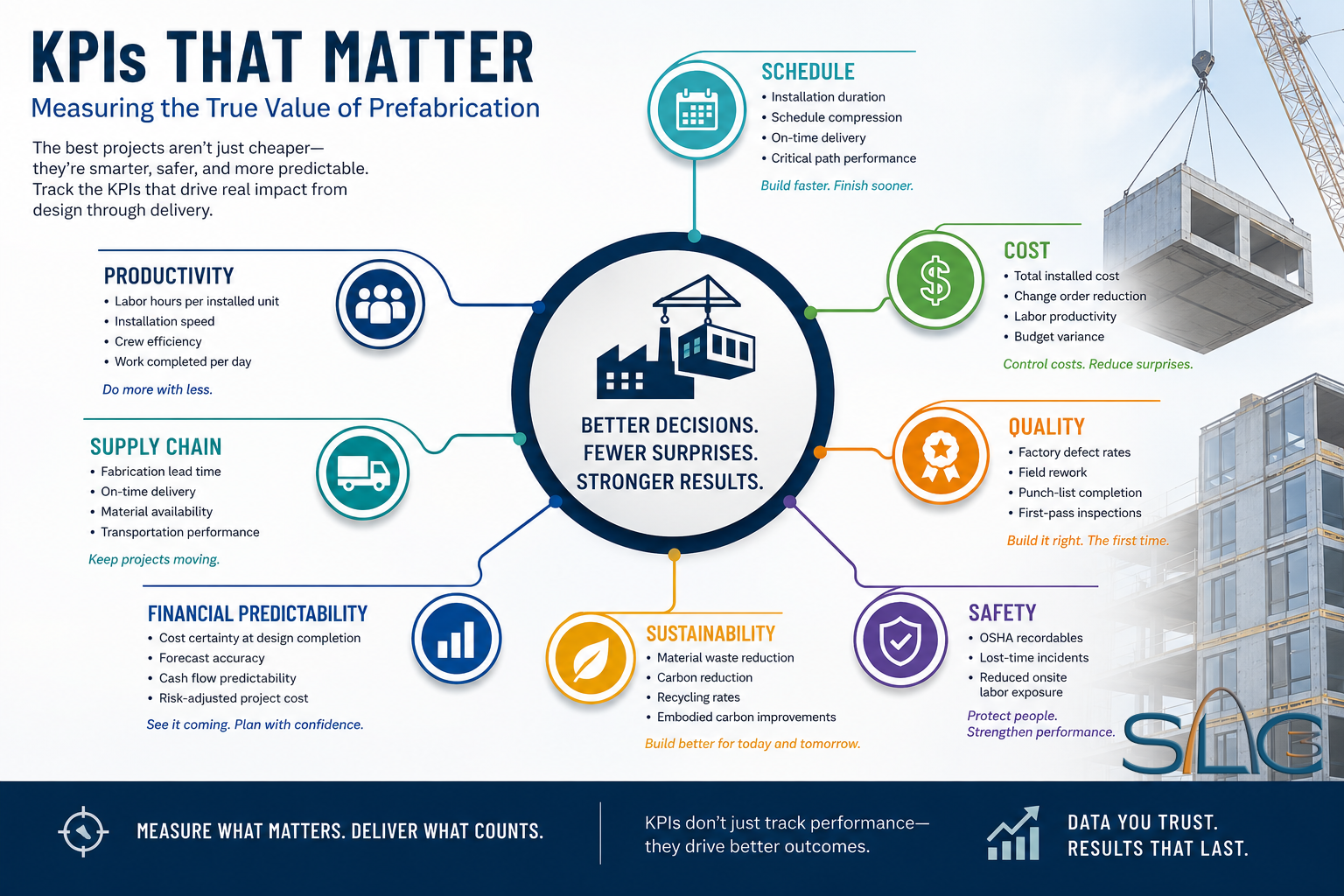
Rather than measuring prefab solely by dollars saved, leading organizations are tracking broader performance metrics, including:
Schedule
- Installation duration
- Schedule compression
- On-time delivery
- Critical path performance
Cost
- Total installed cost
- Change order reduction
- Labor productivity
- Budget variance
Quality
- Factory defect rates
- Field rework
- Punch-list completion
- First-pass inspections
Safety
- OSHA recordables
- Lost-time incidents
- Reduced onsite labor exposure
Supply Chain
- Fabrication lead times
- Delivery reliability
- Transportation performance
Financial Predictability
- Cost certainty during design
- Forecast accuracy
- Cash flow predictability
- Risk-adjusted project performance
A New Definition of Value
The future of construction isn’t about finding the cheapest way to build.
It’s about building with greater confidence.
When owners reduce uncertainty, they reduce the risk of schedule overruns, costly redesigns, quality issues, and safety incidents. Those outcomes may not always appear as line-item savings, but they can have a far greater impact on project success.
The conversation around prefab is evolving—and perhaps that’s the biggest shift of all.
Construction isn’t redefining cost savings. It’s redefining value.