The construction industry has always trained people to do their jobs better. But there is a new question worth asking:
Are we training people for the jobs they have today, or for the jobs those roles are becoming?
The distinction matters.
A project manager’s job is changing. So is the work of an estimator, superintendent, architect, engineer, safety professional, marketer and owner representative.
Technology is part of that change, but this conversation is bigger than software.
Today’s AEC professionals are being asked to interpret more information, coordinate across more disciplines, make decisions faster, communicate with increasingly complex project teams and adapt to tools that may not have existed when they entered the industry.
That means continuing education has to evolve, too.
Technical Knowledge Is Still Essential. It Just Isn’t Enough.
Knowing your discipline remains the foundation. The industry still needs people who understand how buildings go together, how projects are delivered, how risk is managed and how quality and safety are maintained.
But technical knowledge increasingly sits alongside another set of capabilities.
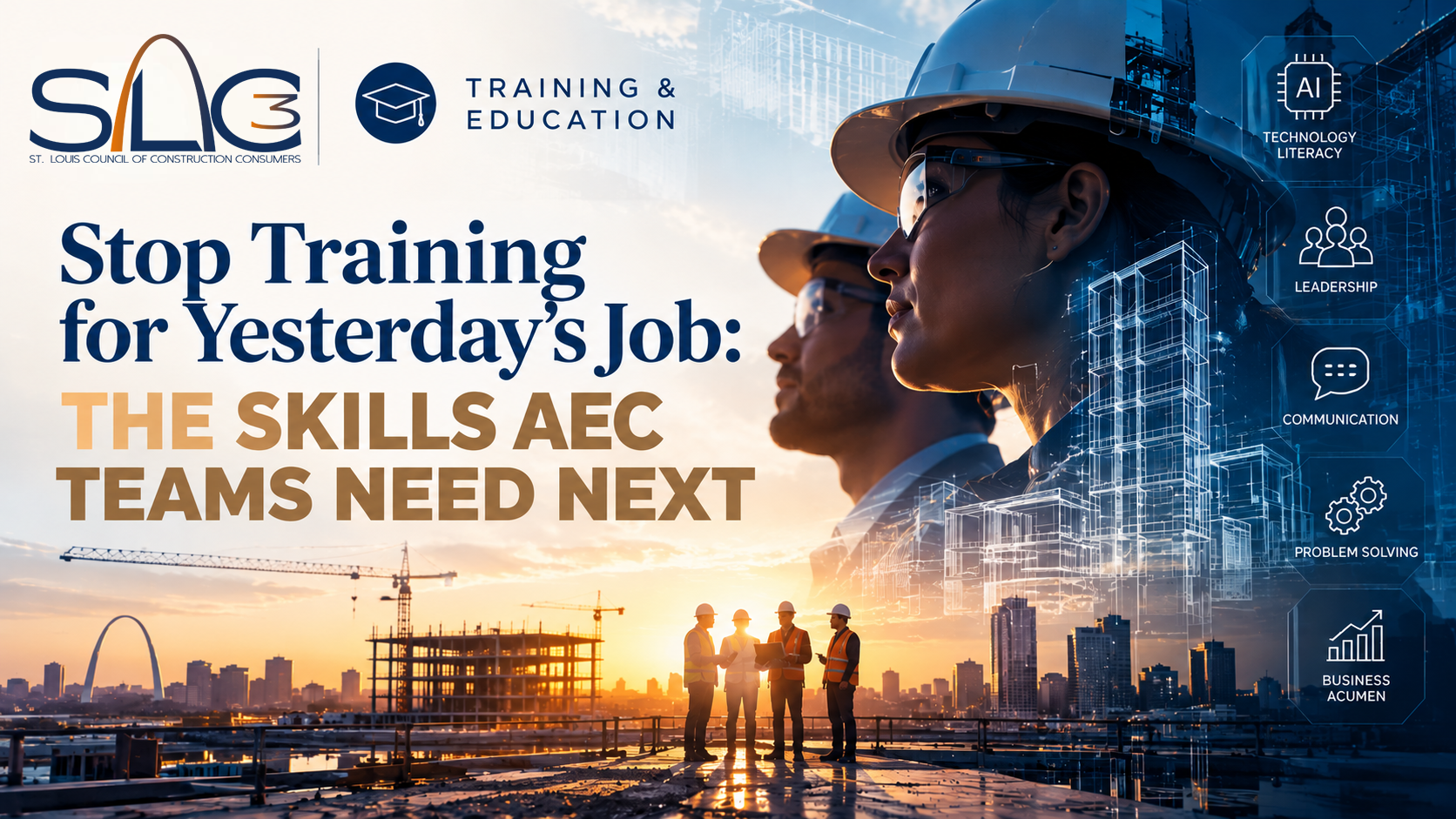
The professionals positioned to grow over the next several years will need to know how to:
- Use technology intelligently, not simply operate it.
- Evaluate information and recognize when something doesn’t look right.
- Communicate risk before it becomes a crisis.
- Work effectively across generations and disciplines.
- Understand the business behind the project, not only their piece of it.
- Learn new tools without abandoning sound judgment.
- Lead conversations even when they aren’t the person with the highest title.
Those aren’t “soft skills.” On a complicated project, they are performance skills.
AI Literacy Is Becoming Part of Professional Literacy
Artificial intelligence deserves particular attention because its adoption is moving faster than most traditional training cycles.
The goal shouldn’t be to turn everyone in an AEC company into an AI expert.
It should be to make sure employees understand enough to use these tools responsibly.
That includes knowing what AI does well, what information should never be entered into an unapproved platform, how to verify an AI-generated answer and when professional expertise must override a technological shortcut.
The employee who knows how to ask an AI tool a question is useful.
The employee who knows whether the answer makes sense is far more valuable.
The Next Skill Gap May Be Between Disciplines
There is another opportunity hiding in the training conversation: helping people understand the work happening around them.
An architect does not need to become a superintendent. An estimator does not need to become an engineer. An owner representative doesn’t need to master every trade.
But understanding how another discipline sees a project can make everyone better at their own job.
Imagine more education built around questions such as:
- What does an owner need to know before approving a change?
- What does a superintendent wish designers understood about constructability?
- What information does an estimator need earlier?
- What creates risk for a subcontractor?
- What does a design team need from the field to make faster decisions?
- What does the next person in the process need from me?
That kind of cross-disciplinary education can improve more than individual knowledge. It can improve the way entire project teams work together.
Build a Learning Plan, Not Just a Training Calendar
Many organizations already have a calendar of required training.
The bigger opportunity is to create a learning strategy.
Start with four questions:
- What skills does our workforce need today?
- What skills will our projects require three years from now?
- Where are our most important knowledge gaps?
- Who inside our organization already knows something we need to teach others?
The answers may point toward formal classes. They may also lead to mentoring, jobsite learning, peer discussions, technology demonstrations, cross-training or short educational sessions built around real project challenges.
Training doesn’t always have to mean sitting in a classroom for half a day.
Sometimes the best education starts with the right 30-minute conversation.
The Industry Is Changing. Curiosity Has to Keep Up.
Construction will always depend on experience.
But experience alone cannot prepare us for something we have never encountered before.
The strongest organizations will be the ones that combine what their experienced professionals already know with the curiosity to keep learning what comes next.
That’s the opportunity in front of our industry.
Not simply to train more.
To become better learners.