
Your email notification pops up.
You look.
A Teams message comes in.
You answer.
Someone texts.
You respond.
Then you return to what you were doing and try to remember exactly where you left off.
Sound familiar?
One of the biggest drains on our capacity isn’t necessarily the amount of work we have. It’s the constant interruption of that work.
And somewhere along the way, many of us started confusing something new with something urgent.
Incoming Doesn’t Mean Important
When a message arrives, it immediately gets our attention simply because it’s new.
But ask yourself:
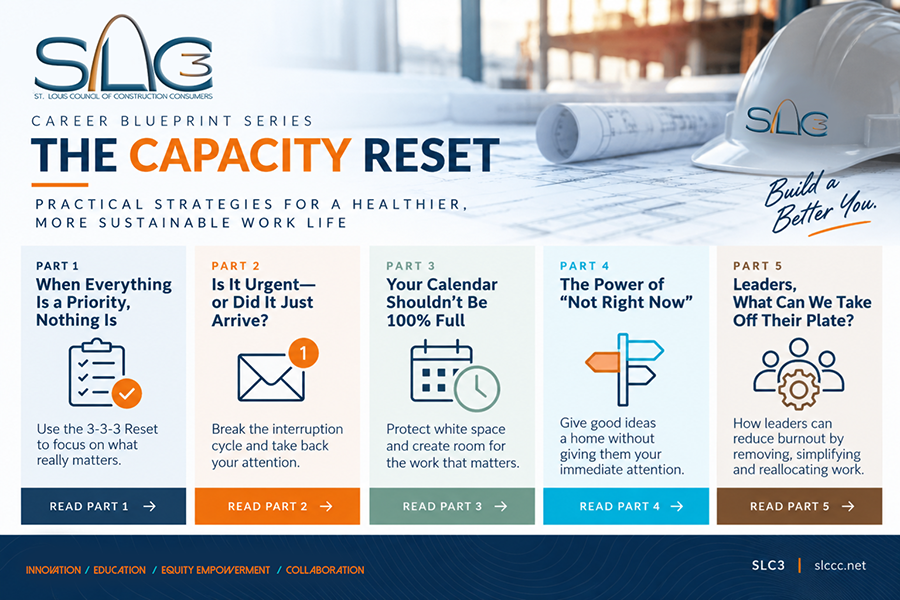
Is this actually urgent—or did it just arrive?
Those are two very different things.
Some things absolutely require an immediate response. A jobsite issue affecting safety, a client emergency or a decision holding up a project can’t necessarily wait.
But that doesn’t describe every email in your inbox.
Yet when we treat every incoming request with the same urgency, we’re allowing other people to continuously rearrange our priorities.
The Cost of “Just Checking”
We often tell ourselves:
“I’ll just check my email really quickly.”
But checking rarely ends with checking.
You read something. You respond. Another message catches your attention. You remember something else you need to do.
Ten minutes later, you’re three tasks away from where you started.
Then you have to mentally return to the original task.
Repeat that throughout the day and it’s easy to understand why you can be exhausted at 5 p.m. while wondering what you actually accomplished.
Try a 60-Minute Focus Block
Here’s your challenge:
Protect one uninterrupted hour.
Close your inbox.
Silence Teams or other notifications.
Put your phone somewhere you can’t automatically reach for it.
Then work on one thing.
Not five things.
One.
If an hour seems impossible, start with 30 minutes.
The point isn’t becoming unavailable all day. It’s creating small periods when your attention belongs to you rather than whoever happens to contact you next.
Create Response Windows
If your role allows it, consider checking and responding to routine messages at designated times instead of continuously.
For example:
Check first thing in the morning.
Again before lunch.
Again mid-afternoon.
And once before leaving.
Your schedule may require something completely different. That’s fine.
The goal isn’t following a particular formula.
It’s becoming intentional about when you respond instead of spending your entire day reacting.
Leaders, This Applies to Us Too
There’s another side to this conversation.
Every time we send an employee a message, we may unintentionally create urgency.
Before sending that 8 p.m. email or weekend text, consider whether it actually needs attention now.
If it doesn’t, say so—or schedule it to send during working hours.
Creating healthier capacity isn’t only about teaching people to manage interruptions.
It’s also about creating fewer unnecessary interruptions for each other.
Try This Today
The next time your phone buzzes, an email appears or a message pops onto your screen, don’t automatically switch tasks.
Ask yourself one question:
“Is it urgent—or did it just arrive?”
If it’s urgent, handle it.
If it’s not, finish what matters first.
Your inbox doesn’t always get to decide your priorities.