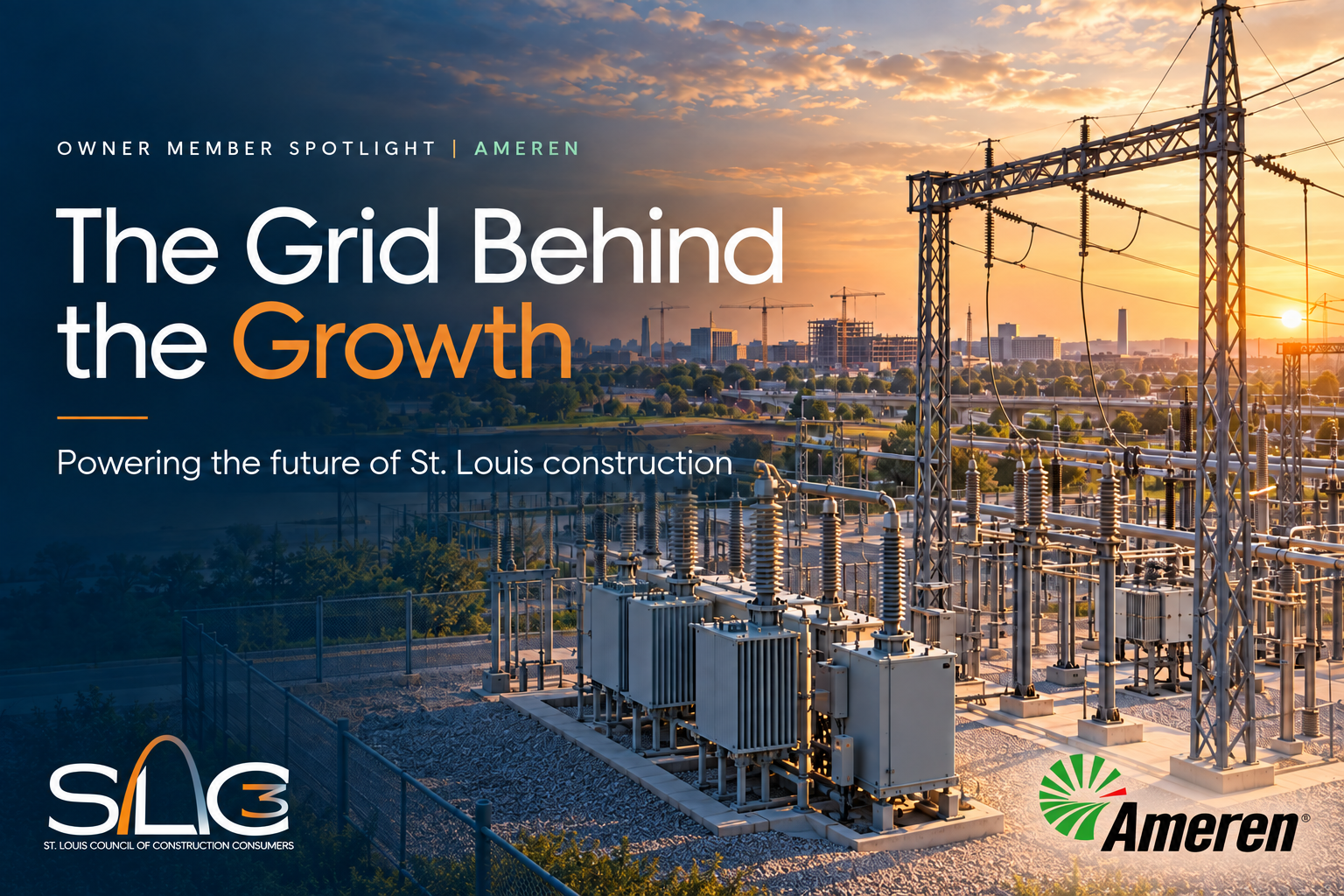
OWNER MEMBER SPOTLIGHT | AMEREN
The buildings attracting the most attention across St. Louis may be data centers, manufacturing facilities, hospitals and major redevelopment projects.
But none of them happen without the infrastructure behind them.
A newly released economic-impact study from Ameren provides a timely reminder that the region’s construction pipeline is increasingly connected to another enormous category of investment: the electric grid.
According to the study, Ameren’s operations, infrastructure improvements and economic-development activity supported approximately 63,000 jobs and $25.9 billion in economic output across Missouri and Illinois in 2025. Ameren also reported spending approximately $2.5 billion with in-state vendors.
Those numbers tell an economic story. For the AEC industry, they also tell an infrastructure story.
Growth Starts Before the Building
As St. Louis competes for increasingly sophisticated projects, site readiness means much more than available acreage.
Owners considering major investments must understand:
- Available electrical capacity
- Transmission and distribution infrastructure
- Substation requirements
- Utility lead times
- Redundancy and reliability requirements
- Future expansion capacity
- Coordination between utility infrastructure and project schedules
Those questions are particularly important for power-intensive facilities such as advanced manufacturing operations, research facilities, healthcare campuses and data centers.
In other words, some of the most important work determining whether a future St. Louis project moves forward may happen well before a construction trailer arrives on site.
Modernizing an Aging System
That work is already visible locally.
In July, Ameren Missouri energized an upgraded substation in Dellwood serving approximately 4,500 customers in north St. Louis County. The project replaced equipment that had been in service for more than 60 years and incorporated modern switchgear and automated controls designed to identify problems and restore service more efficiently.
A single substation project may not command the same attention as a new skyline-changing development, but investments like it are fundamental to the region’s ability to support both existing communities and future growth.
A Different Kind of Construction Pipeline
For St. Louis’ AEC community, utility modernization creates work across a broad spectrum of disciplines.
It can require civil and electrical engineering, site development, underground utilities, substations, transmission and distribution systems, controls, communications, concrete, structural work, environmental services and specialized construction.
It also adds another source of demand to a regional construction market already balancing major investments in aviation, healthcare, manufacturing, infrastructure and technology.
That makes coordination increasingly important.
As owners plan future capital projects, utility capacity and infrastructure schedules should be part of early project conversations rather than issues addressed after design is underway.
Infrastructure as Economic Development
There is a larger takeaway for the region.
Economic development is often measured by the project that ultimately gets announced: a new plant, corporate expansion, research facility or technology campus.
But the ability to win those projects depends partly on infrastructure that may have been planned years earlier.
Roads must carry the traffic. Water and sewer systems must accommodate the demand. Communications infrastructure must provide connectivity. And the electrical grid must be able to reliably supply increasingly sophisticated facilities.
For St. Louis, strengthening that foundation may prove just as important as recruiting the next major project.
The buildings may be what we see.
The infrastructure behind them is what makes growth possible.