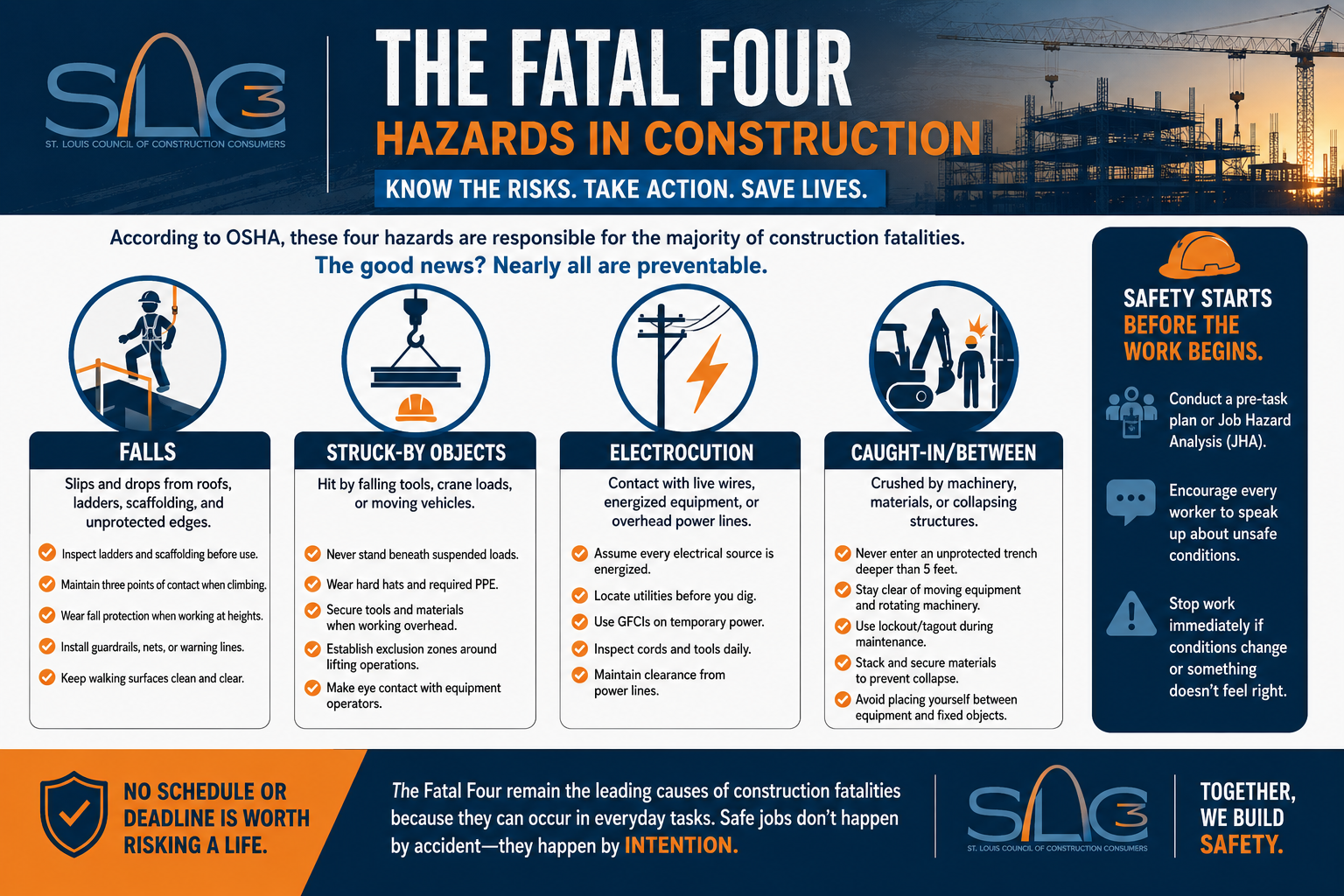
According to the Occupational Safety and Health Administration (OSHA), the majority of construction fatalities stem from four preventable hazards known as the Fatal Four. Understanding the risks is important—but taking proactive steps to eliminate them is what saves lives.
Falls
The Hazard: Slips and falls from roofs, ladders, scaffolding, and unprotected edges remain the leading cause of fatalities in construction.
Mitigation Tips:
- Always inspect ladders and scaffolding before use.
- Maintain three points of contact when climbing.
- Wear properly fitted fall protection when working at heights.
- Install guardrails, safety nets, or warning lines whenever possible.
- Keep walking surfaces clean and free of debris or cords.
Struck-By Objects
The Hazard: Workers are struck by falling tools, suspended loads, equipment, or moving vehicles.
Mitigation Tips:
- Never stand beneath suspended crane loads.
- Wear hard hats and other required PPE at all times.
- Secure tools and materials when working overhead.
- Establish exclusion zones around lifting operations.
- Make eye contact with equipment operators before entering their work area.
Electrocution
The Hazard: Contact with energized equipment, exposed wiring, or overhead power lines.
Mitigation Tips:
- Assume every electrical source is energized until verified otherwise.
- Locate underground and overhead utilities before work begins.
- Use Ground Fault Circuit Interrupters (GFCIs) on temporary power.
- Inspect extension cords and power tools daily.
- Maintain required clearance distances from power lines.
Caught-In/Between
The Hazard: Workers become trapped, crushed, or pinned by equipment, collapsing trenches, or shifting materials.
Mitigation Tips:
- Never enter an unprotected trench deeper than 5 feet.
- Stay clear of moving equipment and rotating machinery.
- Use proper lockout/tagout procedures during maintenance.
- Stack and secure materials to prevent shifting or collapse.
- Avoid placing yourself between heavy equipment and fixed objects.
Safety Starts Before the Work Begins
The best safety programs don’t rely on luck—they rely on planning.
Before starting work each day:
- Conduct a Job Hazard Analysis (JHA) or pre-task planning meeting.
- Encourage every worker to speak up about unsafe conditions.
- Stop work immediately if conditions change or something doesn’t feel right.
- Remember: No schedule or deadline is worth risking a life.
Takeaway: The Fatal Four remain the leading causes of construction fatalities because they can occur in everyday tasks. The good news is that nearly all are preventable through planning, training, communication, and a commitment to looking out for one another. Safe jobs don’t happen by accident—they happen by intention.