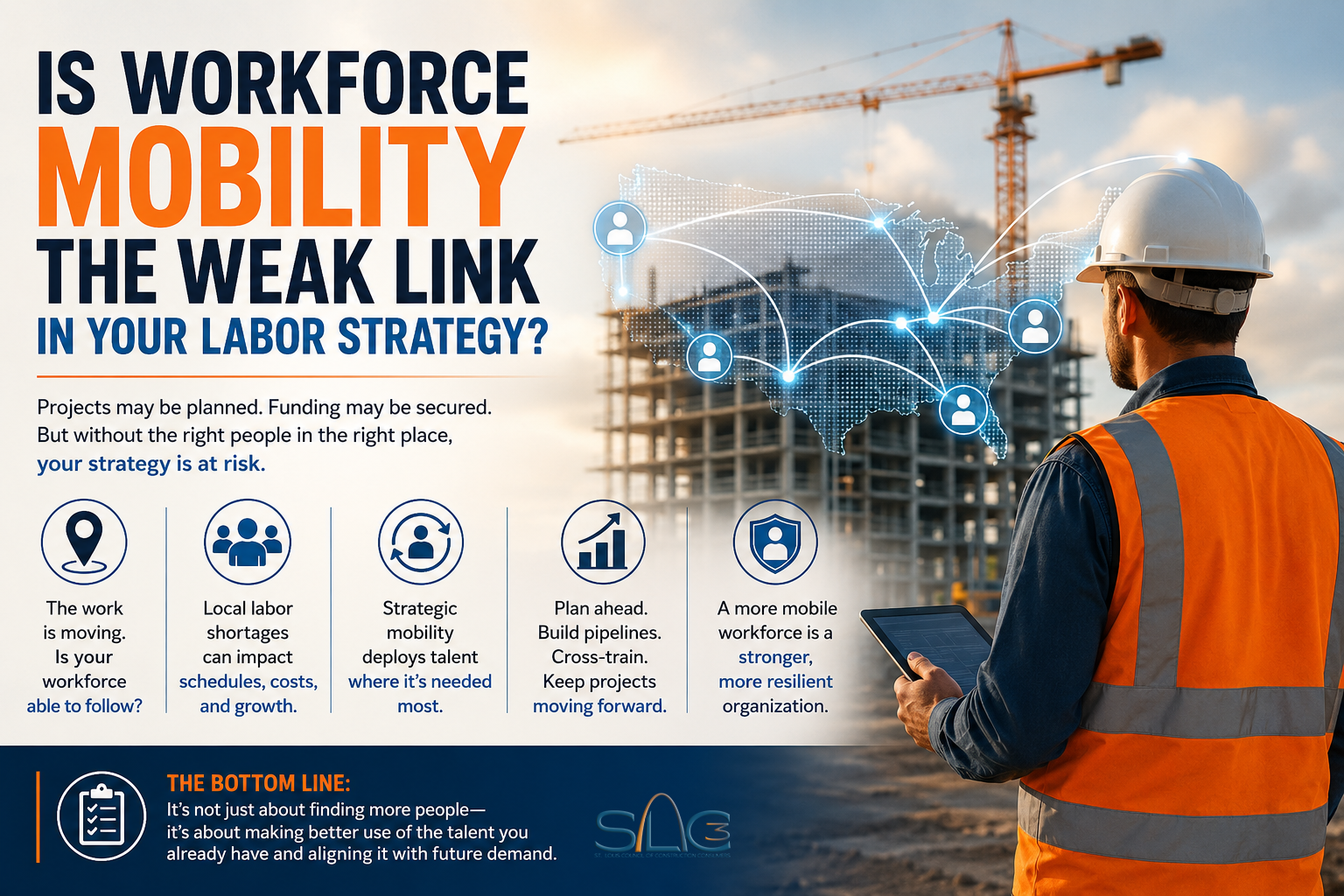
For years, the construction industry has relied on one simple assumption: when the work moves, the workforce will follow.
That assumption is becoming less reliable.
Owners, contractors, and design firms are all feeling the pressure of labor shortages, yet many organizations continue to focus almost exclusively on recruitment. The real question may not be how many people you can hire, but whether your workforce can get to where it’s needed when it’s needed.
Workforce Mobility Is Changing
Today’s workforce has different priorities than previous generations. Family commitments, housing costs, longer commutes, and quality of life are influencing where people are willing to work. Recent construction workforce research also suggests that workers are becoming less willing to travel long distances for projects, creating regional labor shortages even when qualified workers exist elsewhere.
For owners planning billion-dollar capital programs, this creates a significant risk. Having funding, design teams, and materials ready means little if skilled labor isn’t available locally.
Mobility Is More Than Geography
Workforce mobility isn’t just about relocating craft workers.
It also includes:
- Moving experienced employees between projects.
- Cross-training workers to perform multiple roles.
- Developing leadership pipelines that can support new markets.
- Using technology to coordinate staffing across offices and jobsites.
- Creating career paths that encourage employees to stay with your organization.
The companies winning today’s labor battle aren’t always hiring the most people—they’re deploying the people they already have more strategically.
Questions Every Organization Should Ask
Instead of asking “Do we have enough people?” consider asking:
- Are our best people available where demand is growing?
- Which projects are competing for the same talent?
- How quickly can we reassign staff without disrupting other work?
- Are we building local talent pipelines before projects begin?
- What roles are most difficult to replace if someone leaves?
These questions often reveal workforce constraints long before schedules begin slipping.
Building a More Mobile Workforce
Organizations are beginning to rethink workforce planning by:
- Investing in regional partnerships with schools, apprenticeship programs, and workforce organizations.
- Cross-training employees to increase flexibility.
- Using workforce analytics to forecast labor needs months in advance.
- Offering relocation assistance or travel incentives when appropriate.
- Creating internal mobility programs that allow employees to pursue new opportunities without leaving the company.
Some firms are also finding success by relocating existing employees between projects rather than competing in an already strained hiring market. This approach can improve retention, preserve institutional knowledge, and reduce hiring costs.
The Bottom Line
The labor shortage isn’t simply about finding more people.
It’s about making better use of the talent you already have while strengthening local workforce pipelines for the future.
As project schedules accelerate and competition for skilled professionals intensifies, workforce mobility may become one of the most important—and most overlooked—competitive advantages in construction.
Key Takeaways
- Workforce mobility is becoming a strategic issue, not just an HR issue.
- Regional labor availability can determine project success.
- Internal talent mobility often costs less than external recruiting.
- Cross-training and workforce planning improve organizational resilience.
- Companies that proactively align talent with future project demand will be better positioned to deliver projects on time and on budget.