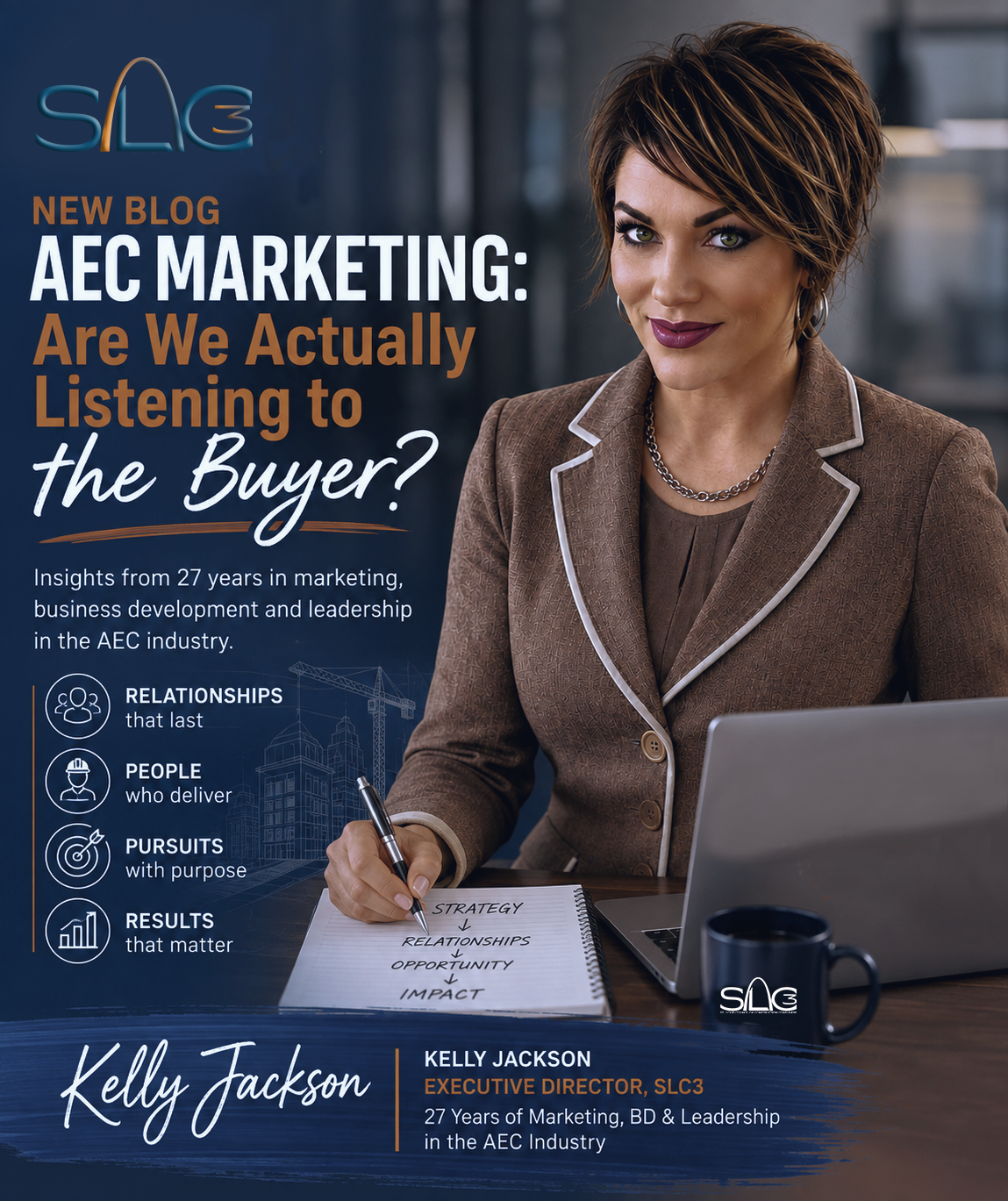
By Kelly Jackson
AEC firms spend significant time and money pursuing work—networking, attending events, preparing qualifications, developing proposals and hiring business development professionals.
But there is an important question firms should ask:
Are our marketing and business development efforts aligned with how owners actually want to buy?
Through industry research, years of experience, and conversations with buyers of design and construction services—suggest there is a disconnect.
#1. Stop Making Business Development a Revolving Door
Relationships matter tremendously as you know, so why is there so much change? Business owners frequently experience turnover among the business development professionals assigned to their organizations locally and elsewhere. This has grown significantly in the last 5 years.
Every departure can mean starting over: new introductions, new explanations of priorities and another person learning the owner’s organization. Not to mention more of the owner’s time and frankly, patience.
That’s particularly problematic in an industry built heavily around repeat business. And if you are in an area with many alternative choices, you may not be the choice next time.
Relationships should therefore belong to the firm, not just one business developer.
Better approach: Create multiple connections within important accounts. Introduce leadership, project managers, and technical professionals early so the relationship survives personnel changes. Owners and partners will take notice.
#2. Owners Want to Meet the People Doing the Work
One of the clearest findings in AEC business development research is the importance of the seller-doer. When I came into the industry in the late 1990’s, it was the norm and rare to have non-technical degree professionals in BD roles. Today, it’s more common to have non-technical BD professionals opening doors and managing prospecting, while seller-doers are closing.
Research from SMPS Foundation and Stambaugh Ness found that 89% of AEC firms use seller-doers. A major driver is client preference for meeting the professionals who would actually work on their projects.
That means your BD professional may open the door—but shouldn’t always walk through it alone.
Bring your project executive, architect, engineer, superintendent, estimator, project manager or subject-matter expert into the conversation when appropriate.
The person who sells the work and the people who deliver it should not feel like two completely different companies.
3. Don’t Wait for the RFP to Start Marketing
If your first serious conversation about an opportunity occurs when the RFP arrives, you may already be behind.
AEC buyers research firms well before formal procurement begins. They are looking at experience, reputation, referrals, expertise, and whether a firm understands their organization and challenges.
Business development should therefore be about learning before selling.
Ask:
- What is driving this project?
- What concerns the owner most?
- What happened on previous projects?
- What expertise will really matter?
- What constraints could affect delivery?
- What does success look like to this particular owner?
That intelligence should ultimately shape the pursuit.
4. Relevant Experience Beats a Long Project List
One common marketing mistake is confusing more experience with more relevant experience.
Twenty vaguely similar projects aren’t necessarily more compelling than three highly relevant examples.
Don’t simply tell an owner:
“We’ve done this before.”
Explain:
“We’ve encountered the challenge you’re facing, here’s how we addressed it, here’s what we learned and here’s how that experience benefits your project.”
Relevant experience becomes considerably more powerful when you translate it into reduced risk, better decision-making or improved outcomes for the client. Hint: My use of relevance charts was a very persuasive feature in my responses.
5. Pursue Strategically—or Don’t Pursue
Not every opportunity deserves a proposal.
Strong AEC marketing includes disciplined go/no-go decisions.
Before consuming dozens—or hundreds—of staff hours preparing qualifications, determine whether you understand the owner, project, competition and selection criteria.
Ask yourself:
Why should we win this project?
If the honest answer is essentially “because we’re qualified,” you probably don’t have a pursuit strategy yet.
Qualifications get you into the conversation. Differentiation gives the owner a reason to select you.
6. If You Lose, Find Out Why
A lost pursuit shouldn’t simply disappear into the CRM as “Lost.”
Ask for a debrief.
What separated the selected team? Was your experience relevant enough? Did the interview hurt you? Was another firm’s project approach stronger? Did you misunderstand the owner’s priorities?
And perhaps most importantly:
What would make us more competitive next time?
AEC firms spend enormous resources pursuing work. Not asking why you lost wastes one of the most valuable pieces of market research available—and it’s often free.
7. Follow Through
This may be the simplest marketing strategy of all.
If you tell an owner you’ll send information—send it.
If you promise an introduction—make it.
If you say you’ll check back—check back.
If someone gives you useful information—remember it.
If you lose a pursuit—stay connected.
AEC business development is rarely about one brilliant sales pitch. It is the cumulative result of dozens of interactions that demonstrate reliability, competence, curiosity and trustworthiness.
8. Think Strategically About Partnerships
Owners aren’t simply evaluating individual companies. Increasingly, they are evaluating the strength of the entire team.
Strategic partnerships shouldn’t be assembled simply to fill boxes on an organizational chart.
Ask:
- Does this partner strengthen our weaknesses?
- Do they add experience we genuinely need?
- Have we worked together successfully?
- Do our cultures and working styles align?
- Does the partnership create measurable value for the owner?
The strongest teaming strategy answers the question:
“Why is this combination of firms particularly well suited for this project?”
—not simply “Who do we need on the team?”
The Takeaway: Market Less. Listen More.
Perhaps the biggest opportunity in AEC marketing isn’t another proposal template, CRM system, networking event or social media campaign.
It’s getting closer to the buyer.
Build relationships that extend beyond one business developer. Put project leaders and technical experts in front of clients. Learn before the RFP. Pursue selectively. Demonstrate relevant—not merely extensive—experience. Ask why you lost. Follow through. And build partnerships intentionally.
Because ultimately, owners aren’t buying your marketing. They’re deciding whether they trust your people to deliver their project.