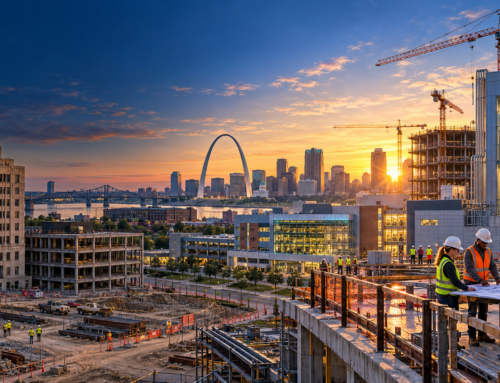
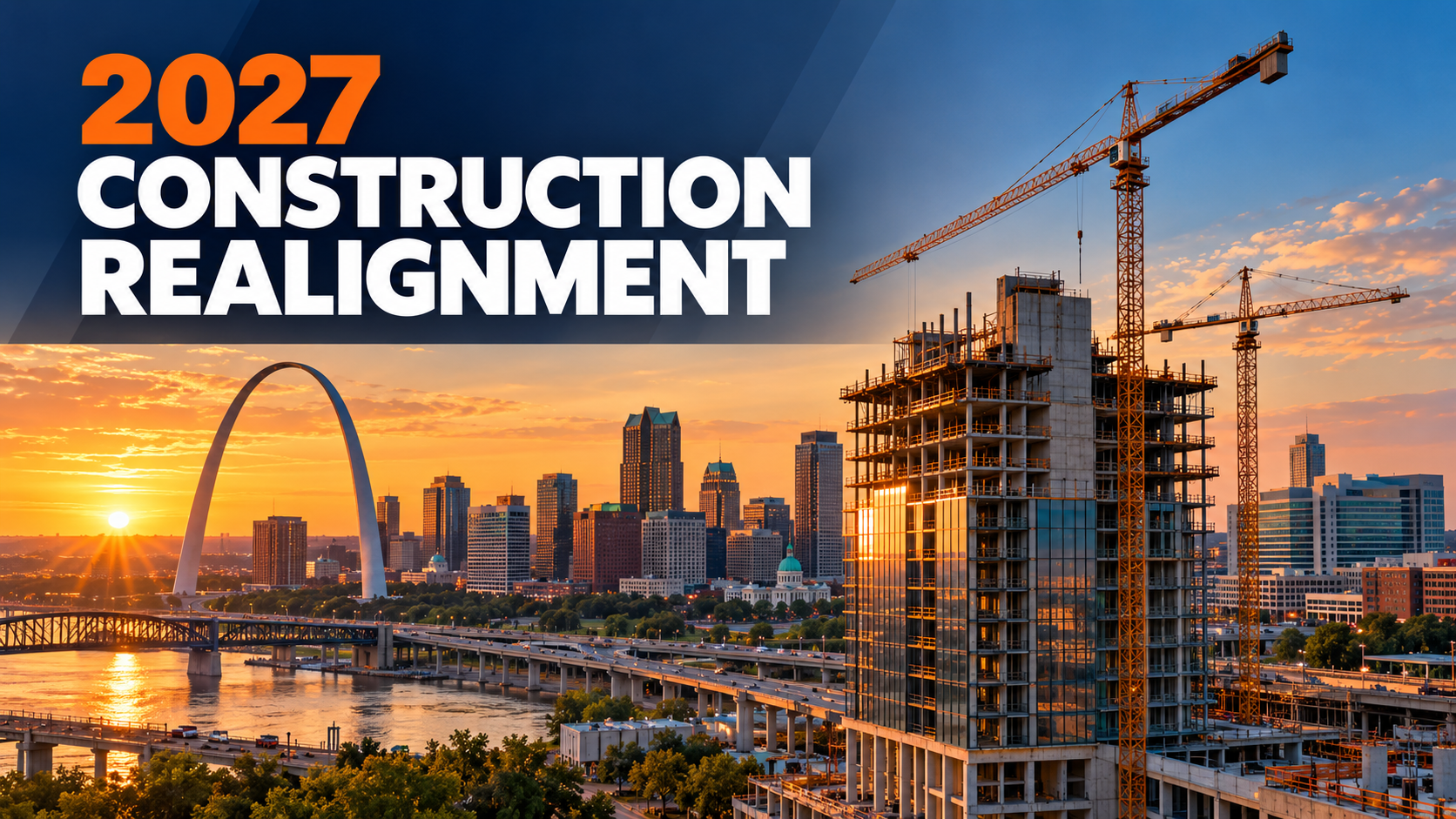
Piggybacking from last week…the construction industry moves from the historic highs of recent years into a period of more measured growth; the outlook for 2027 is not simply about expansion or contraction. It is about realignment.
ConstructConnect projects Midwest nonresidential construction starts to stabilize near $131.5 billion in 2027, following a forecasted moderation in 2026. That figure represents the broader Midwest—not Greater St. Louis alone—but the region is positioned to capture significant activity through transportation infrastructure, healthcare, residential development, institutional investment, and urban revitalization. (news.constructconnect.com)
The result is a Greater St. Louis construction market that remains active but increasingly selective. The strongest opportunities are emerging in projects tied to long-term public needs, regional connectivity and developments capable of attracting residents, businesses and investment.
A $9.2 Billion Infrastructure Pipeline
Infrastructure is one of the clearest strengths in the region’s 2027 outlook.
The St. Louis Regional Freightway’s 2027 Priority Projects List includes 29 projects representing more than $9.2 billionin investment across Eastern Missouri and Southwestern Illinois. As of May 2026, nearly $3.8 billion in funding had been secured, approximately $1.6 billion in projects was under construction and more than $581 million in listed projects had been completed. (St. Louis Regional Freightway)
The list reflects the interconnected nature of the bi-state economy. Highways, bridges, rail facilities, ports and the airport function as one regional freight system—and each investment can influence industrial development, manufacturing capacity and access to developable land.
Among the major priorities are:
- The proposed $3 billion-plus modernization of St. Louis Lambert International Airport, the largest initiative on the Freightway list. Approximately $1 billion had been identified or secured as planning advanced.
- Continued improvements along the I-270 corridor, including projects supporting one of the region’s most important freight routes.
- The $106 million Illinois Route 3 Connector, a fully funded project designed to improve traffic flow, accessibility and network connectivity.
- A proposed $98 million expansion of the Madison multimodal rail yard, intended to increase capacity within one of the nation’s leading rail hubs.
- Future work associated with major Mississippi River crossings, freight rail infrastructure, ports and industrial corridors.
These investments do more than create individual construction opportunities. Together, they strengthen the region’s position as a national logistics and manufacturing center—and support the sites, facilities and workforce required for future private development. (thetelegraph.com)
City Road and Mobility Improvements Continue
Within the City of St. Louis, MoDOT’s 2026–2027 construction program includes several projects that will remain active or reach important milestones in 2027.
Improvements along Route H/Riverview Drive include pavement and safety work scheduled during 2027. Along Route D—Page Boulevard and portions of Dr. Martin Luther King Drive— crews are completing corridor-wide safety, sidewalk, signal, and resurfacing improvements that began in 2026 and will continue into 2027.
The I-64 interchange near Grand Boulevard also remains a closely watched future investment. Its importance extends beyond vehicular movement: the project has the potential to improve connections among surrounding institutions, neighborhoods, transit systems, and pedestrian routes.
For the AEC community, these projects reinforce a growing priority. Infrastructure is no longer evaluated only by how efficiently it moves vehicles. Owners and communities increasingly expect projects to improve safety, accessibility, multimodal connectivity and the surrounding development environment.
Major Buildings Approach 2027 Milestones
Several prominent vertical projects are expected to change the region’s skyline and institutional landscape.
Albion West End
At Lindell Boulevard and Kingshighway, Albion West End is expected to be completed in 2027. The approximately 30-story development will bring more than 300 apartments and ground-floor retail space to one of the region’s most visible intersections near Forest Park.
The tower reached its structural topping-out milestone in 2026, making it one of the clearest physical signs of continued residential confidence in the Central West End. (theljc.com)
New SSM Health Cardinal Glennon Children’s Hospital
Healthcare construction will deliver one of the region’s most consequential projects in late 2027: the new SSM Health Cardinal Glennon Children’s Hospital.
The 14-story, 200-plus-bed pediatric hospital reached its structural topping-out milestone in 2026. The replacement facility is being developed to provide an expanded, highly coordinated environment for pediatric inpatient, neonatal, outpatient, and specialty care.
This project demonstrates why healthcare remains a stabilizing force in the construction market. Hospitals and medical campuses must continually respond to changing clinical practices, technology, patient expectations, and population needs—creating demand for highly specialized design, engineering, and construction expertise.
Lambert Represents a Long-Term Regional Transformation
Although the full redevelopment will extend well beyond 2027, the proposed modernization of St. Louis Lambert International Airport may be the region’s most significant long-range construction initiative.
The program is envisioned as a multibillion-dollar transformation of the passenger experience, with terminal, concourse, roadway, parking, utility and support-facility improvements potentially advancing through multiple phases. Current planning looks toward a transformed airport serving the region’s needs into the next decade. (St. Louis Lambert International Airport)
For the construction industry, Lambert should be viewed as more than one future project. A program of this scale can create opportunities across architecture, engineering, construction management, specialty contracting, technology, security, logistics and supplier services.
Downtown: Momentum, Opportunity and Unfinished Work
Downtown St. Louis remains the region’s greatest redevelopment challenge—and potentially one of its greatest construction opportunities.
Demolition of the former Millennium Hotel has entered its final phase, preparing the prominent riverfront property for possible redevelopment. The Gateway Arch Park Foundation and The Cordish Companies have presented a proposed $670 million, 1.3-million-square-foot mixed-use vision incorporating residential, office, retail, restaurant, cultural and public spaces. (Gateway Arch Park Foundation)
The distinction is important: the site is being cleared, but the $670 million redevelopment remains a proposed, longer-term development rather than a project scheduled for completion in 2027.
Even so, removing the vacant hotel represents meaningful progress. A cleared and development-ready site beside the Gateway Arch creates possibilities that did not exist while the deteriorating structure remained in place.
Downtown redevelopment could also benefit from Missouri’s newly enacted Innovation, Public Safety and Accountability Act. Effective August 28, 2026, the legislation establishes a framework through which qualifying cities may designate innovation zones and access state-administered incentives. These may include employer retention and relocation programs, office-to-residential conversion assistance, opportunity-zone benefits and incentives supporting startup investment. (house.mo.gov)
The law creates new tools, but it does not guarantee development on its own. Local planning, district designation, private investment, financing and infrastructure coordination will determine how effectively those tools translate into actual projects.
What the 2027 Pipeline Tells Us
Greater St. Louis is not entering 2027 with a single dominant construction story. It is entering the year with several distinct markets moving at different speeds.
Infrastructure and healthcare offer the greatest long-term stability. Major residential projects demonstrate targeted confidence in strong neighborhoods. Airport and freight investments strengthen the region’s national competitiveness. Downtown presents substantial opportunity, but many projects will require patient coordination among owners, developers, public agencies and financing partners.
That is the reality of a realigning market: not every sector rises together, and not every announced vision is construction-ready.
For SLC3 members, the opportunity is to understand where projects stand today—proposed, funded, under construction or nearing delivery—and prepare accordingly. That means strengthening owner relationships, anticipating workforce demands, developing the right project partnerships and remaining engaged as public and private investment decisions take shape.
The cranes in the air tell only part of the story. The deeper story is a region building the infrastructure, institutions and development framework that will influence Greater St. Louis for decades to come.
Enjoyed this? Join us in December as we hear directly from industry leaders. In January, we will host Charles Gascon for our update from the Federal Reserve St. Louis.
By: Kelly Jackson