
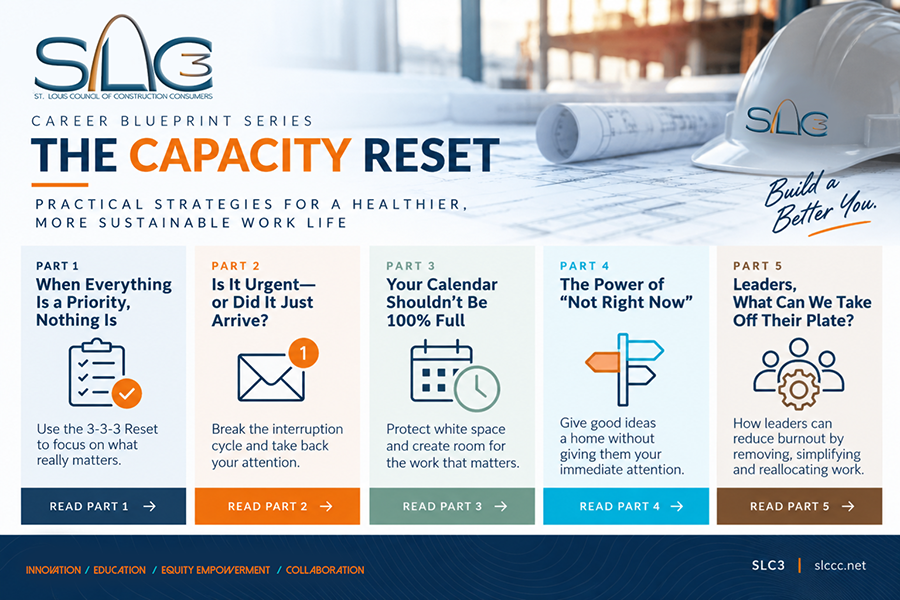
Your Calendar Shouldn’t Be 100% Full
Take a look at your calendar for this week.
How much open space do you see?
If the answer is almost none, we may have found part of the problem.
We’ve somehow created a workplace culture where a completely full calendar can look like productivity.
Meeting at 8. Meeting at 9. Project call at 10. Lunch meeting. Teams call at 1. Committee meeting at 2. Client meeting at 3.
Then 4:30 arrives and you finally have time to…
work.
That’s a problem.
A Full Calendar Doesn’t Mean Full Capacity
Meetings are work. They require attention, decisions, preparation and follow-up.
But they’re often not the only work we’re responsible for.
We still have proposals to prepare, projects to manage, drawings to review, clients to contact, estimates to complete, employees to lead and decisions to make.
When every hour is scheduled, all of that work has to go somewhere.
Too often, it goes into the evening.
Or early morning.
Or the weekend.
And eventually, we start calling that normal.
Leave Room for the Unexpected
AEC professionals know better than most that the day rarely goes exactly as planned.
A project condition changes.
A client needs something.
A deadline moves.
A problem surfaces in the field.
Someone on your team needs help.
If your calendar is already operating at 100% capacity, where does the unexpected go?
Usually on top of everything else.
Think about your calendar the way you would think about a project schedule.
Would you intentionally build a project schedule with absolutely no room for the unexpected?
Probably not.
Your workweek deserves some contingency too.
Try the 15% Rule
Here’s something to experiment with:
Leave approximately 15% of your workweek intentionally unscheduled.
For a 40-hour week, that’s about six hours.
That doesn’t mean six hours of doing nothing.
It’s capacity for:
- Focused work
- Unexpected problems
- Follow-up
- Thinking and planning
- Helping your team
- Catching up when something runs long
You don’t necessarily need six consecutive hours. Protect an hour here, 30 minutes there, or even one meeting-free block each week.
Before Accepting Another Meeting…
Ask three questions:
Do I actually need to be there?
Does this need to be a meeting?
Could we accomplish the same thing in 15 minutes instead of an hour?
We often schedule meetings because that’s what we’ve always done—not because a meeting is still the best way to accomplish the work.
And if you’re leading the meeting, take another look at the invitation list.
Does everyone really need to attend?
Giving someone an hour back may be one of the easiest ways to improve their capacity.
Protect White Space
Here’s your challenge this week:
Open your calendar and find one block of time you can protect.
Maybe it’s Tuesday morning from 8–10.
Maybe it’s Friday afternoon.
Maybe it’s simply 30 minutes between major meetings instead of scheduling them back-to-back.
Protect it.
Don’t apologize for it.
And don’t immediately fill it because someone sees an opening on your calendar.
White space isn’t wasted time. It’s working capacity.
Because if every minute of your week is already spoken for, you haven’t planned a productive week.
You’ve planned a week with no room for real life.