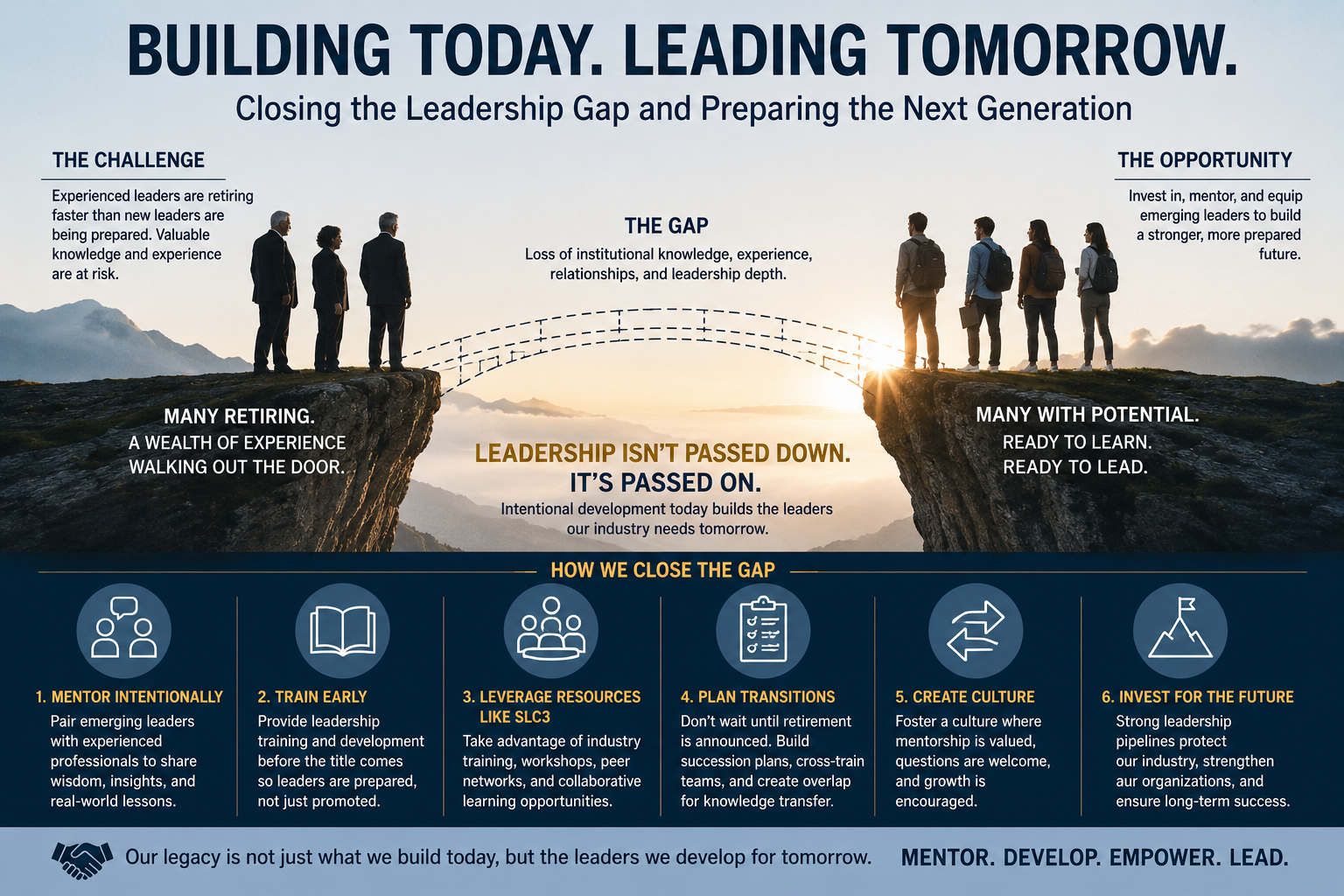
Across many industries today, there is a growing concern that a leadership gap is forming. Experienced professionals are retiring faster than new leaders are being prepared to replace them. Decades of institutional knowledge, relationship-building skills, operational judgment, and crisis experience are walking out the door—and in many cases, there is not a strong enough pipeline ready to step in.
This issue is especially important in industries built on technical expertise, infrastructure, operations, customer relationships, and long-term trust. Leadership is not learned overnight. It is developed through years of mentorship, exposure, coaching, and hands-on experience.
For too long, many organizations assumed the next generation would simply “pick it up along the way.” But the workplace has changed. Career paths are less linear. Employees move between organizations more often. Fewer people are staying in one place long enough to naturally absorb leadership culture through observation alone.
At the same time, younger professionals are entering the workforce during a period of rapid change and uncertainty. They are technically capable and highly motivated, but many have not yet had consistent opportunities to lead teams, navigate conflict, manage difficult conversations, or make high-pressure operational decisions.
The result is a widening experience gap.
This is not about criticizing the next generation. It is about recognizing that leadership development must become intentional again.
Organizations can begin addressing this now in several practical ways.
- First, mentoring must become a priority rather than an afterthought. Experienced leaders possess knowledge that cannot be fully captured in manuals or procedures. They understand people, timing, relationships, and judgment. Structured mentoring programs create opportunities for those lessons to be passed on before retirements occur.
- Second, leadership training should start earlier. Too often, employees are promoted into management positions before receiving meaningful leadership preparation. Technical expertise alone does not automatically prepare someone to lead people. Communication, emotional intelligence, accountability, conflict resolution, strategic thinking, and decision-making all require development and practice.
This is where organizations like SLC3 can play an important role. Industry associations and collaborative training environments provide opportunities for emerging professionals to learn beyond their day-to-day responsibilities. Leadership workshops, peer networking, succession planning discussions, operational case studies, and mentorship initiatives can help bridge the experience gap while strengthening the industry as a whole.
- Third, companies should create more intentional transition planning. Many organizations wait too long to think about succession. By the time a retirement announcement is made, valuable knowledge transfer opportunities may already be lost. Cross-training, shadowing programs, and phased transition plans can help preserve expertise and build confidence in future leaders.
There is also a cultural component to this challenge. Younger professionals often want mentorship and growth opportunities, but they may hesitate to ask. Senior leaders, meanwhile, may underestimate how much wisdom they truly carry. Leadership development works best when both generations intentionally engage with one another.
The encouraging news is that this problem can still be addressed. The next generation is talented, capable, and eager to contribute. But talent alone is not enough. Leadership pipelines must be built deliberately.
Industries that invest now in mentorship, training, and succession planning will be far better positioned for the future than those that assume leadership development will happen on its own.
Preparing future leaders is not simply about replacing retiring professionals. It is about protecting institutional knowledge, strengthening organizations, and ensuring that the next generation is ready not only to do the work—but to lead it well.