Something feels different in the way people are communicating. Emails are sharper. Texts are shorter. Small misunderstandings escalate quickly. Many people seem ready to assume the worst.
The data suggests this is not just imagination. Americans are carrying a heavy emotional load, and it is spilling into everyday interactions.
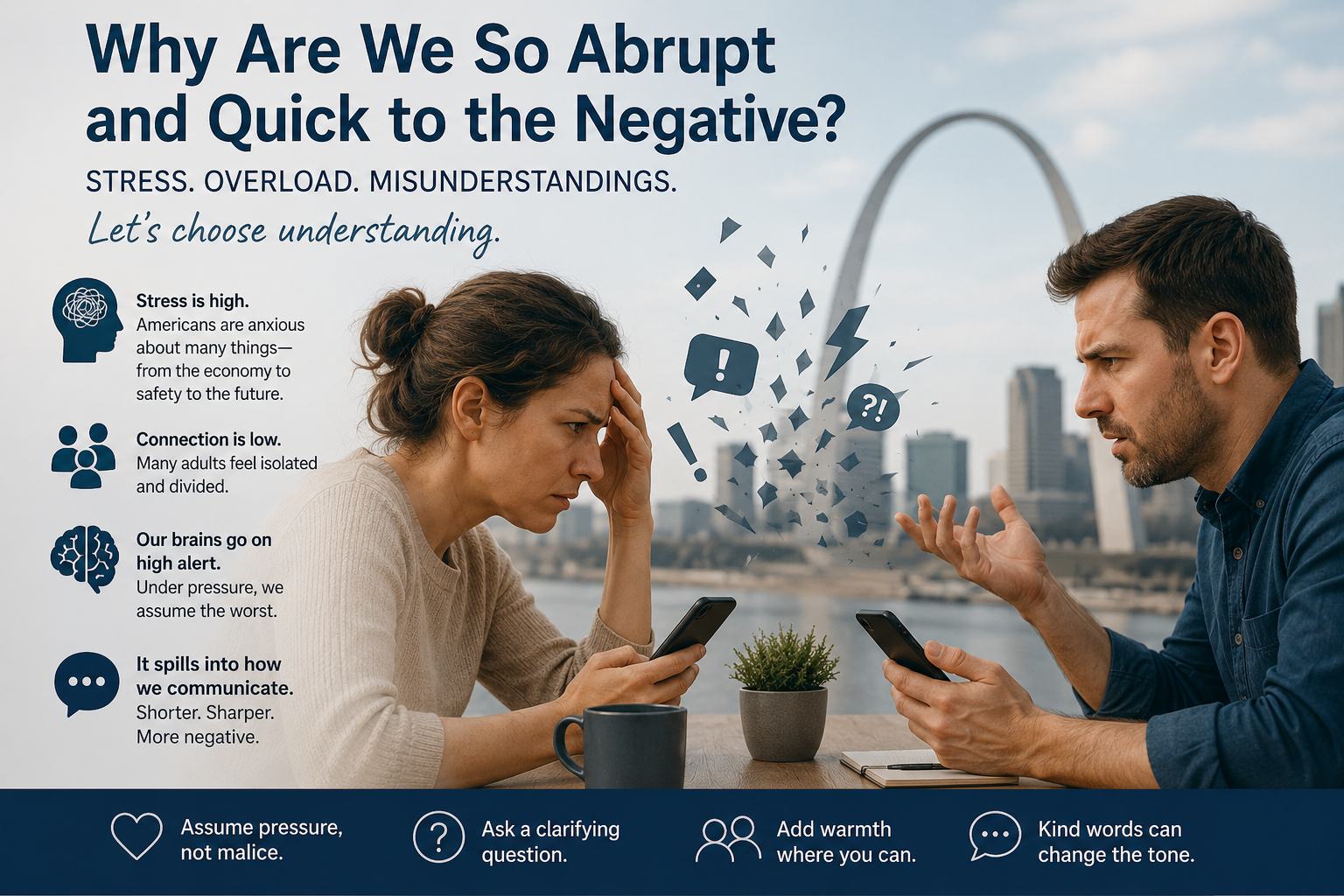
The American Psychological Association’s 2025 Stress in America report describes the country as facing a “crisis of connection,” with 62% of adults saying societal division is a major source of stress and about half reporting feelings of isolation, exclusion, or lack of companionship.
Other polling points in the same direction. In 2025, the American Psychiatric Association found that 67% of Americans were anxious about world events, 62% about keeping themselves or their families safe, and 61% about paying bills or expenses. Stress and sleep were the two most commonly cited factors affecting mental health.
This matters because stress changes how we interpret people. Under pressure, the brain becomes more threat-sensitive. Ambiguous messages can feel hostile. Neutral comments can sound dismissive. Research on interpretation bias finds that stress and negative interpretation patterns are linked, and studies of online behavior show that negative content is more likely to be shared and amplified.
So when someone replies abruptly, jumps to a negative conclusion, or reads criticism where none was intended, it may not simply be rudeness. It may be overload.
The St. Louis region appears to be feeling this too. A 2024 iHeard St. Louis survey found that 48% of surveyed adults believed local mental health had worsened over the previous year, while only 6% believed it was improving. A regional Community Health Needs Assessment also identified mental health as the top community health concern in the St. Louis region, based on input from more than 5,700 community members.
None of this excuses harsh communication. But it does explain why so many interactions feel more brittle. People are financially stretched, politically exhausted, socially disconnected, sleep-deprived, and worried about the future. That creates a shorter fuse.
A helpful response is not to match abruptness with abruptness. It is to slow the exchange down. Assume pressure before malice. Ask one clarifying question. Add warmth where possible. Say, “I may be reading this wrong,” or “Can you help me understand what you meant?” These small phrases can interrupt the cycle.
If many people are communicating from a place of strain, then kindness is not softness. It is a stabilizing force. Right now, a little extra patience may be one of the most practical things we can offer each other.