Concrete is everywhere—from sidewalks and bridges to hospitals, schools, and skyscrapers. Yet despite being one of the most common construction materials on Earth, it’s also one of the most misunderstood. Here are three fascinating facts about the material that literally supports our world.
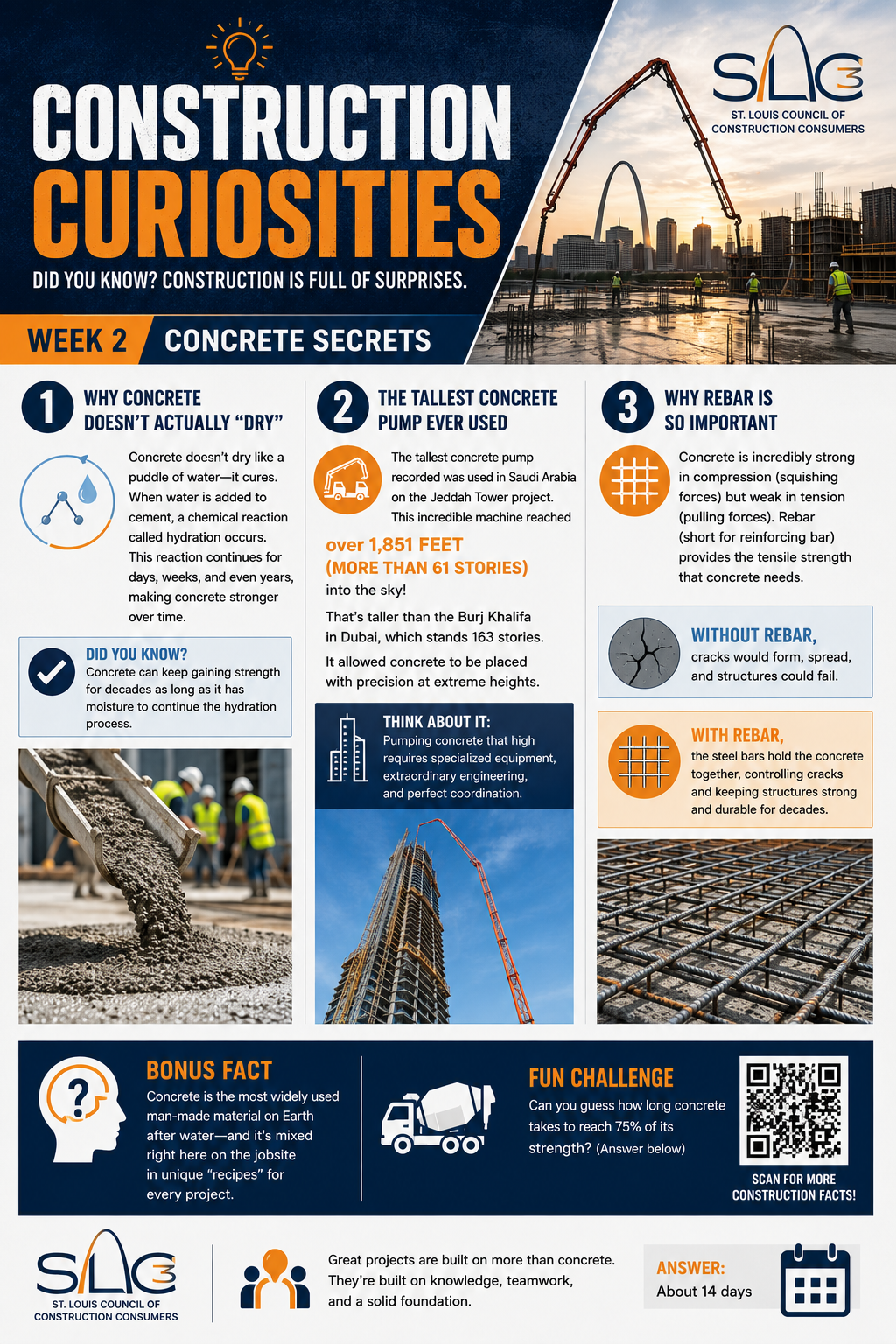
🏗️ Concrete Doesn’t Actually “Dry”
Most people think concrete hardens because the water evaporates. In reality, concrete cures, not dries.
When water is mixed with cement, a chemical reaction called hydration begins. As cement particles react with water, they form microscopic crystals that bind sand and aggregate together into an incredibly strong material.
Here’s the surprising part: as long as moisture is available, that reaction continues. Concrete gains most of its strength within the first 28 days, but it can continue becoming stronger for years.
Why it matters: That’s why contractors carefully protect freshly placed concrete from drying out too quickly. Proper curing improves strength, durability, and resistance to cracking.
🚚 The Tallest Concrete Pump Ever Used
Moving concrete isn’t as simple as pouring it from a truck—especially when you’re building skyscrapers.
One of the world’s tallest concrete pumping operations occurred during construction of the Jeddah Tower in Saudi Arabia. Specialized pumping equipment successfully pushed concrete to a height of 1,851 feet (564 meters)—an engineering achievement that required custom concrete mixes, enormous pump pressures, and precise coordination.
To put that into perspective, that’s higher than many skyscrapers themselves and nearly three and a half times the height of the Gateway Arch.
Why it matters: Every major advancement in pumping technology allows taller, faster, and more efficient construction while improving quality and reducing labor.
🔩 Why Rebar Is So Important
Concrete is incredibly strong when it’s being compressed, but it’s surprisingly weak when it’s pulled or bent.
That’s where reinforcing steel—better known as rebar—comes in.
Steel handles the tension while concrete handles the compression, creating one of the strongest structural combinations in modern construction. Together they form the foundation of bridges, parking garages, hospitals, office buildings, and countless other structures.
Without reinforcement, concrete would crack much more easily under heavy loads or temperature changes.
Why it matters: Proper rebar placement isn’t just about meeting code—it’s essential to the long-term safety, strength, and service life of a structure.
💡 Concrete Curiosity
Did you know that concrete is the most widely used man-made material on Earth? Only water is consumed in greater quantities worldwide.
The next time you walk through a building, drive across a bridge, or visit a stadium, remember there’s far more science and engineering beneath your feet than meets the eye.